


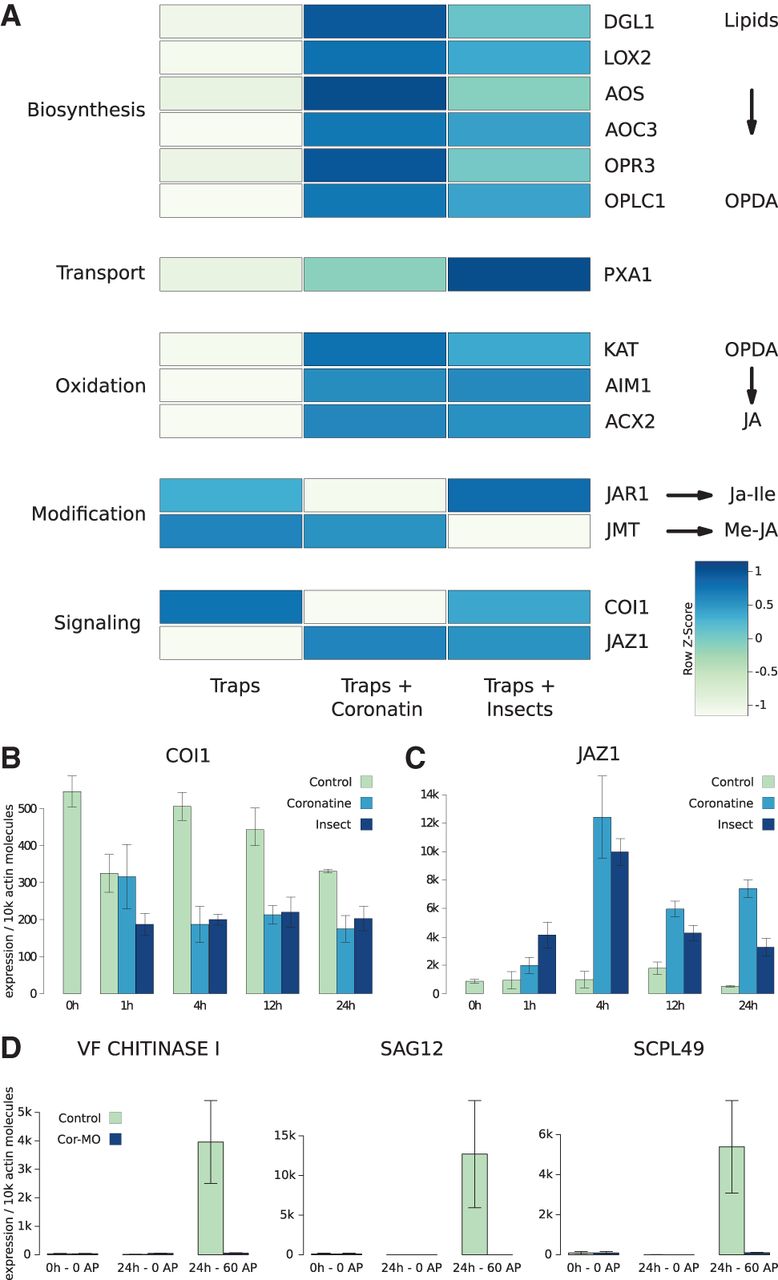
Activated Venus flytraps show signs of elevated jasmonate signaling. (A) Heat map depicting the expression of key genes mediating jasmonate biosynthesis, transport, and signaling in activated (COR/insect) versus nonstimulated traps. Expression values are scaled by rows (Z-scoring). The majority of the components are transcriptionally activated by insect or COR stimulation in traps and glandular tissue. Genes encoding the key enzymes of jasmonic acid (JA) biosynthesis such as LOX2 (LIPOXYGENASE 2), AOS (ALLENEOXIDE SYNTHASE), and OPR3 (OXOPHYTODIENOATE-REDUCTASE 3) were highly induced in insect- and COR-stimulated traps and glands. Likewise, the ABC-transporter PXA1 (PEROXISOMAL ABC-TRANSPORTER 1) mediating the import of the JA precursor OPDA (12-oxo-phytodioneic acid) into peroxisomes, and peroxisomal enzymes of the beta-oxidation chain generating JA from OPDA were stimulus induced. JAR1 (JASMONIC ACID RESISTANT 1), which finally converts JA into its physiologically active form JA-Ile, appears specifically induced by insects. (B,C) Quantitative PCR (qPCR) of the Dionaea JA receptor COI1 (CORONATINE INSENSITIVE 1) and its coreceptor/repressor JAZ1 (JASMONATE-ZIM-DOMAIN 1). (D) Effect of the JA-antagonist coronatine-O-methyloxime (COR-MO) on electro-mechanical induction of hydrolase expression. Traps were pretreated 4 h before application of zero or 60 APs with H2O (green) or 100 μM COR-MO (blue). Transcript numbers are given relative to 10,000 molecules of DmACT1 ± SE, n = 6. RNA was sampled after 24 h in response to zero or 60 recorded action potentials (APs). qPCR Abbreviations are as follows: (DGL) DONGLE, PLA1-type phospholipase; (LOX2) LIPOXYGENASE 2; (AOS) ALLENE OXIDE SYNTHASE; (AOC3) ALLENE OXIDE CYCLASE 3; (OPR3) 12-OXOPHYTODIENOATE REDUCTASE 3; (OPCL1) OPC-8:0 COA LIGASE1; (PXA1) PEROXISOMAL ABC TRANSPORTER 1; (KAT) PEROXISOMAL 3-KETOACYL-COA THIOLASE 3; (AIM1) ABNORMAL INFLORESCENCE MERISTEM; (ACX2) ACYL-COA OXIDASE 2; (JAR1) JASMONATE RESISTANT 1; and (JMT) JASMONIC ACID CARBOXYL METHYLTRANSFERASE (Dave and Graham 2012).



