


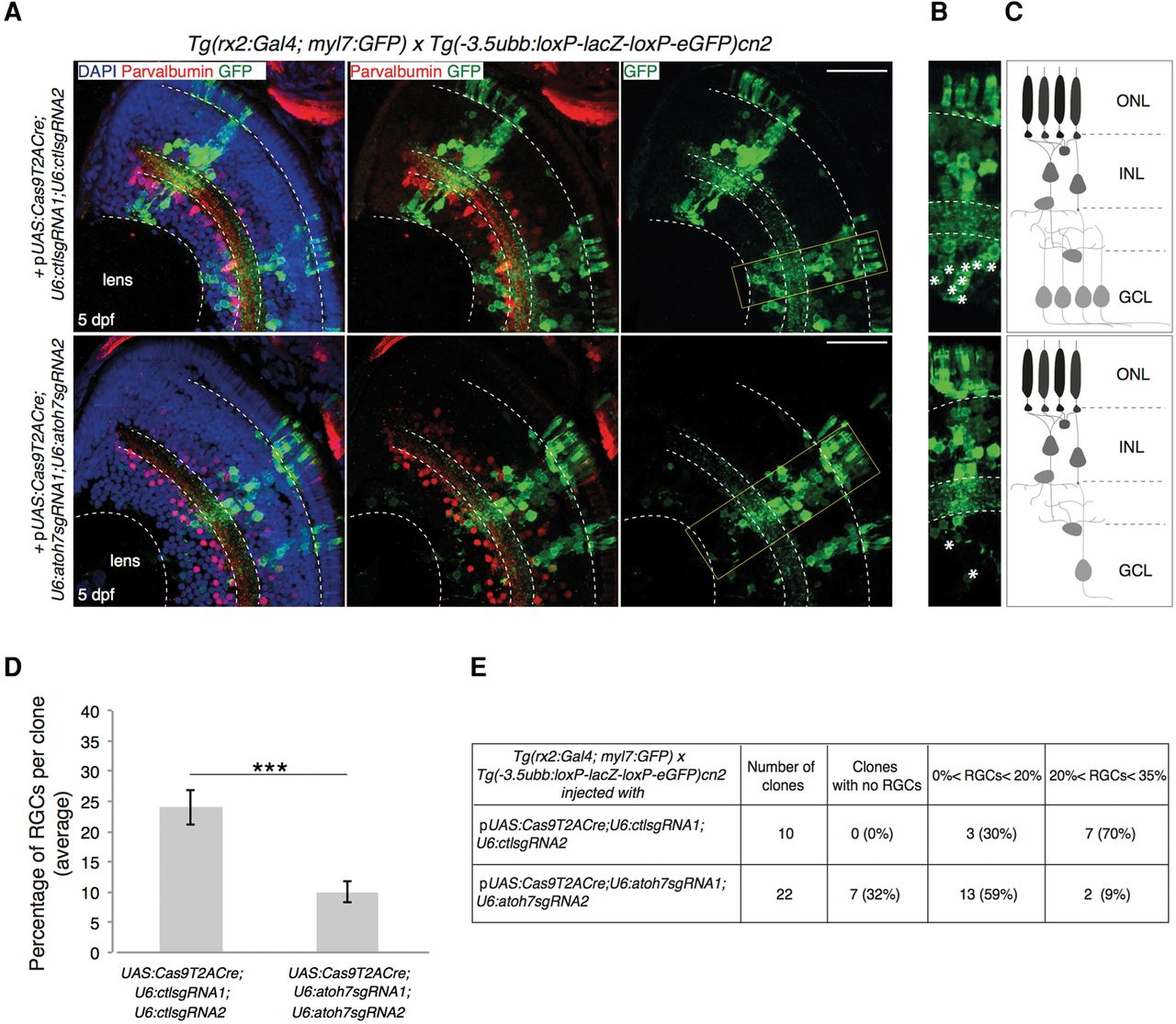
Clonal deletion of atoh7 leads to reduction in RGCs differentiation. Targeting of the atoh7 gene. Atoh7 is a transcription factor essential for the differentiation of retinal ganglion cells (RGCs). The pUAS:Cas9T2ACre;U6sgRNA1;U6sgRNA2 construct, with control or atoh7-specific sgRNAs, was injected in double transgenic embryos Tg(rx2:Gal4; myl7:GFP) × Tg(-3.5ubb:loxP-lacZ-loxP-eGFP)cn2. The latter transgene drives Gal4 expression in retinal progenitor cells. (A) (Upper panel) Differentiated RGCs are detected in wild-type clones injected with the DNA construct containing control sgRNAs. (Lower panel) GFP-labeled mutant clones show reduction of RGCs in the retinal section of a 5 dpf larva, as expected from atoh7 loss-of-function. Quantification of RGCs was done according to soma location in the ganglion cell layer (GCL), and displaced amacrine cells were distinguished by Parvalbumin counterstaining. Scale bar = 100 µm. (B) Higher magnification of the wild-type (upper panel) and atoh7 (lower panel) mutant retinal cell layers. RGCs are indicated by asterisks. (C) A schematic of labeled clones in the zebrafish retinal layers. (ONL) Outer nuclear layer, (INL) inner nuclear layer, (GCL) ganglion cell layer. (D) Quantification of the percentage of RGCs per clone derived from Cas9-expressing cells. Data are represented as mean ± SEM. (***) P-value < 0.001 following Wilcoxon Mann–Whitney test. (E) Table showing the percentage of RGCs per GFP-positive clone in the retinal sections of double transgenic Tg(rx2:Gal4; myl7:GFP) × Tg(-3.5ubb:loxP-lacZ-loxP-eGFP)cn2 embryos microinjected with the 2C-Cas9 vector containing control sgRNAs (first row) or atoh7-specific sgRNAs (second row).



