


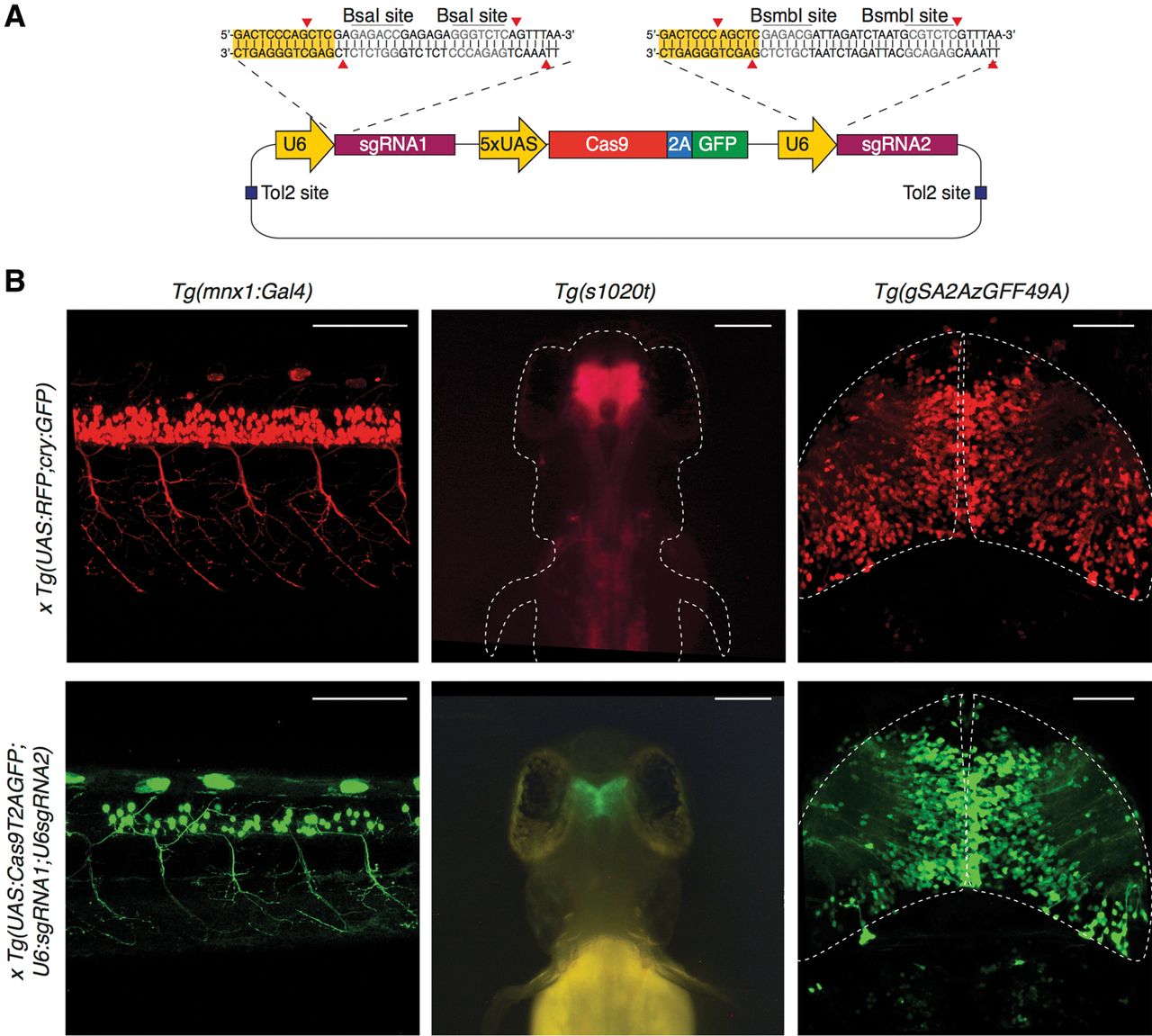
Spatiotemporal control of Cas9 activity via the Gal4/UAS expression system. (A) Schematic illustration of the expression vector design. Spatial and temporal control of Cas9 synthesis is achieved by the Gal4/UAS system and monitored by GFP expression. Two constitutively active U6 promoters drive the transcription of single guide RNAs (sgRNAs) specifically targeting a gene of interest. To facilitate cloning of sgRNA target sequences, BsmbI and BsaI restriction sites (red arrows) were introduced. Tol2 allows efficient transgenesis after injection into one-cell stage zebrafish embryos. (B) (Left panel) Confocal imaging of the spinal cord of 2 dpf Tg(mnx1:Gal4) embryos. The upper image shows the Gal4-induced RFP expression of a double transgenic embryo deriving from a cross between Tg(mnx1:Gal4) and Tg(UAS:RFP; cry:GFP) fish. The same pattern is observed in the GFP channel in a double transgenic Tg(mnx1:Gal4) × Tg(UAS:Cas9T2AGFP;U6sgRNA1;U6sgRNA2) embryo (lower image). Scale bar = 100 µm. (Middle panel) Imaging of whole-mount 3 dpf Tg(s1020t) enhancer-trap line. The GFP expression pattern (lower panel) recapitulates RFP (upper panel). Scale bar = 100 µm. (Right panel) Confocal imaging of 5 dpf optic tectum in the double transgenic embryos deriving from a cross of Tg(gSA2AzGFF49A) gene-trap line and Tg(UAS:RFP,cry:GFP) (upper image) and Tg(UAS:Cas9T2AGFP;U6sgRNA1;U6sgRNA2) (lower image). Scale bar = 50 µm. No target sequence was inserted in the vector for the generation of the Tg(UAS:Cas9T2AGFP;U6sgRNA1;U6sgRNA2) line.



