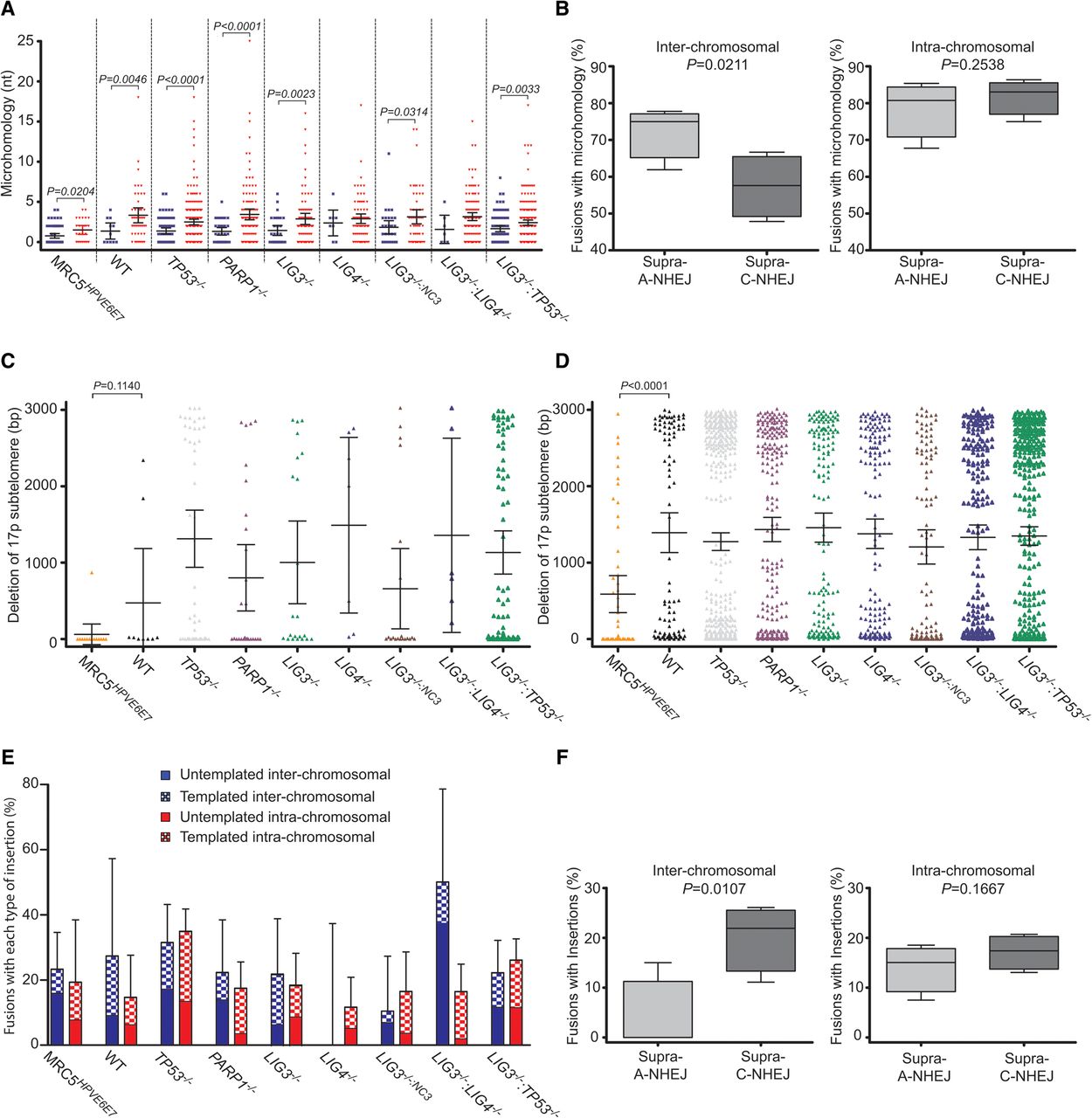
Differential processing of inter- and intra-chromosomal fusion junctions in crisis-stage MRC5HPVE6E7 and 17p TALEN-treated HCT116 cell lines. (A) Microhomology usage (≥1 bp sequence overlap) at each fusion junction plotted as a scatter chart with mean values and 95% CI for each sample. Mean nucleotides of microhomology at inter-chromosomal fusion junctions (blue crosses) are significantly lower (two-tailed unpaired t-test, Welch's correction) for all samples (except LIG4−/− and LIG3−/−:LIG4−/−) than the corresponding intra-chromosomal fusion junctions (red triangles). (B) The approximate 25% increase in percentages of inter-chromosomal (left) but not intra-chromosomal (right) fusion junctions with microhomology identified for Supra-A-NHEJ (LIG4−/− and LIG3−/−:NC3) over Supra-C-NHEJ (PARP1−/− and LIG3−/−) samples is statistically significant (P = 0.0211, one-tailed unpaired t-test with Welch's correction). Resection from the 17p TALEN cleavage site (HCT116) or telomere repeats (MRC5HPVE6E7) for each 17p inter-chromosomal (C) or intra-chromosomal (D) fusion chromatid plotted as a scatter chart with mean base pair and 95% CI, revealing notable length asymmetry of intra-chromosomal fusion partners. The greater than twofold lower mean resection of MRC5HPVE6E7 compared with HCT116 WT chromatids was statistically significant (P < 0.0001) by one-tailed unpaired t-test with Welch's correction. (E) The percentages of inter-chromosomal (blue) and intra-chromosomal (red) fusion junctions containing insertions (<50 bp) plotted with 95% CI including subclassification of events as templated (≥2 nt sequence similarity; checkered boxes) or untemplated (no BLAST nucleotide alignment; solid boxes). (F) The statistical significance (P = 0.0107) of the approximate fivefold increase in mean percentage of inter-chromosomal (left) but not intra-chromosomal (right) junctions with insertions for Supra-A-NHEJ samples was evaluated by one-tailed unpaired t-test with Welch's correction.