


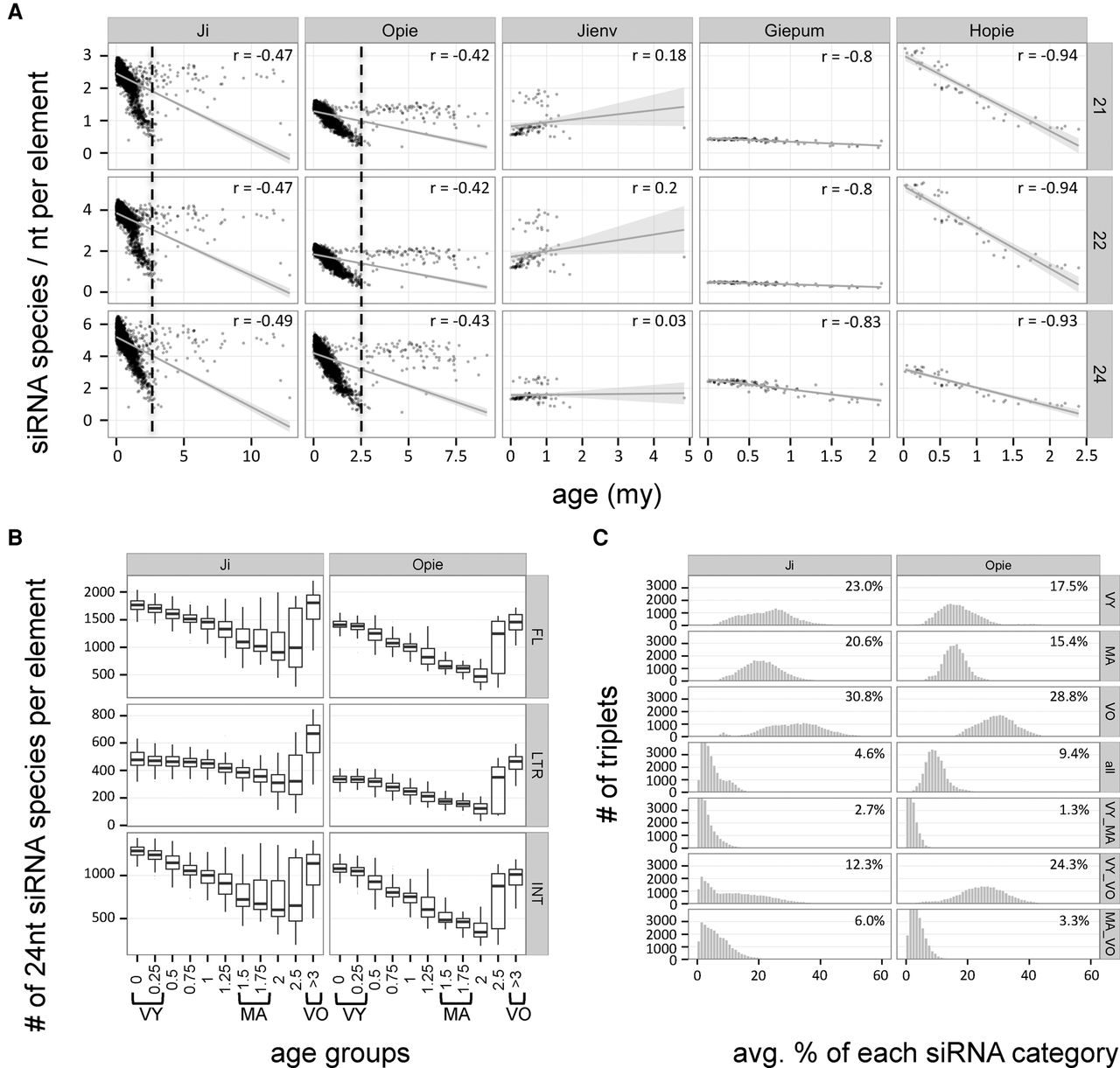
Sirevirus age and siRNA targeting. (A) Relationship between age and number of siRNA species of the leaf library calculated per nucleotide of the full-length sequence for each siRNA length and family separately. The dotted lines indicate the cutoff point around 2.0–2.5 my, after which elements did not exhibit decreased targeting. The shading around each regression line represents the 0.95 confidence interval, while the Pearson r is shown for each plot (P value <10−20 in all cases, except Jienv). (B) Number of 24-nt siRNA species of the leaf library that mapped to the LTRs, INT domain, or full-length sequence of Ji or Opie elements across age groups (see Supplemental Table S4 for their population sizes). Very young (VY), middle-aged (MA), and very old (VO) elements are indicated. (C) Twenty-one nucleotide siRNA species of the immature ear library cross-mapping to the LTRs of 27,000 Ji or Opie triplets. Each siRNA was classified across seven types based on the element(s) of the triplet it mapped to. The average percentage of each type is shown. The y-axis is cut off at 4000 my.



