


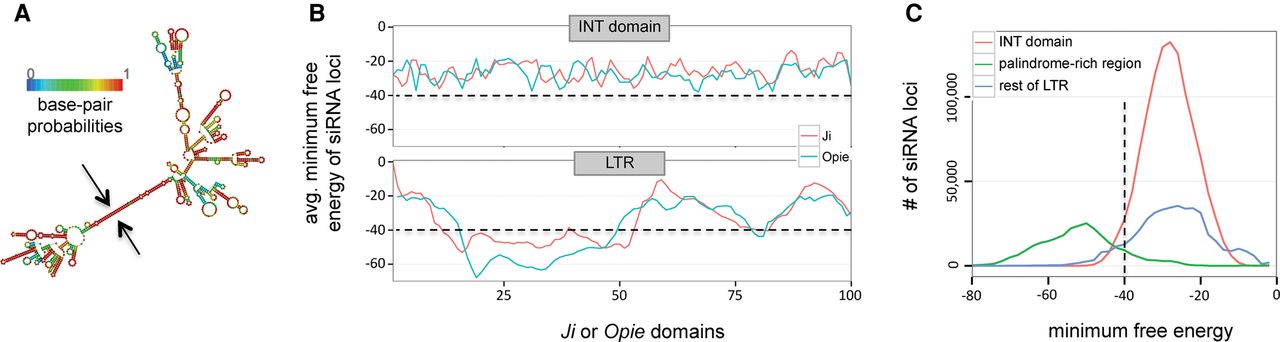
Secondary structure of Sirevirus LTRs. (A) Predicted hairpin formation of the Ji LTR shown in Figure 3A using RNAfold (Gruber et al. 2008). Arrows represent the underlined fragments in Figure 3A. (B) Average minimum free energy (MFE) of the siRNA loci, 20 nt upstream + siRNA length + 70 nt downstream (as in Wang et al. 2009) along Ji and Opie LTRs and INT domains, which were first split in 100 equally sized windows of ∼13-nt and ∼67-nt length, respectively. The lines represent averages for the windows across all elements. (C) Distribution of MFE for siRNA loci mapping to the INT domain, the palindrome-rich region of the LTR (38 windows for Ji; 30 windows for Opie), and the rest of the LTR of all Ji and Opie elements combined. The miRNA cutoff of −40 MFE is highlighted in B and C by dotted lines.



