


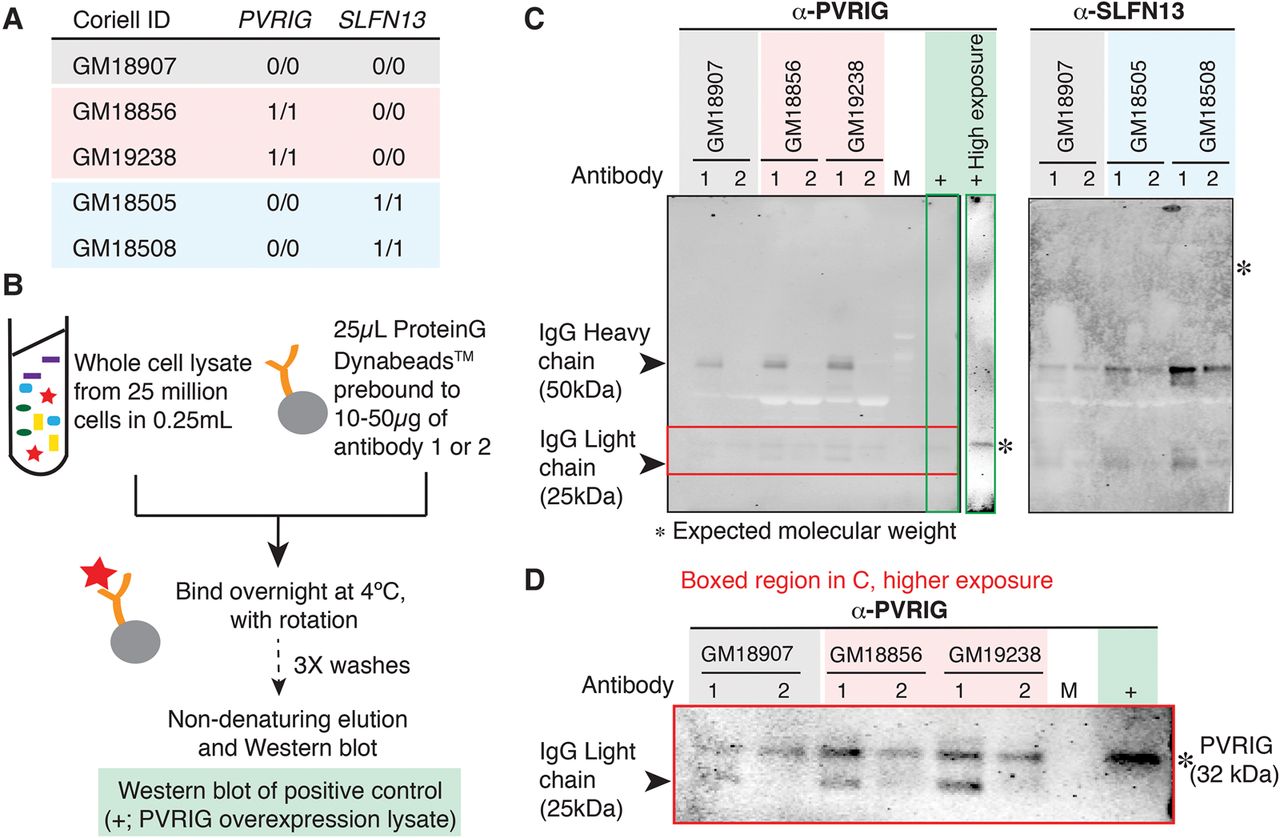
Stop codon readthrough enables protein production from a gene containing a nonsense variant. (A) LCLs used in this study and their genotype for PVRIG and SLFN13. (B) Cartoon depicting the experimental setup for immunoprecipitation and subsequent Western blotting for PVRIG and SLFN13 to measure endogenous protein in the LCLs listed in A. (C) Western blots for PVRIG and SLFN13 on immunoprecipitates that were enriched for the corresponding proteins from the illustrated LCLs. Two distinct antibodies were separately used for protein enrichment, and the antibodies were used together for Western blot detection. (*) Expected molecular weight for PVRIG (detected by both antibodies) and SLFN13 (detected by neither antibody). (M) Marker lane containing the ladder. (+) Positive control for PVRIG (PVRIG overexpression lysate). (+) High exposure, lane for the positive control (green box) shown in a higher exposure to illustrate specificity of the assay. Note that even though nondenaturing elution limits the bulk release of the Protein G–bound antibodies that were used to enrich for the antigen, some antibody release is unavoidable and is visible as heavy and light chains, which migrate at 50 and 25 kDa. Those bands do not interfere with the detection of PVRIG and SLFN13, which are expected to migrate at 32 and 102 kDa, respectively. (D) Higher exposure of the relevant portion (red box) of the PVRIG blot in C. PVRIG was detected by both antibodies at the expected molecular weight in all cell lysates.



