


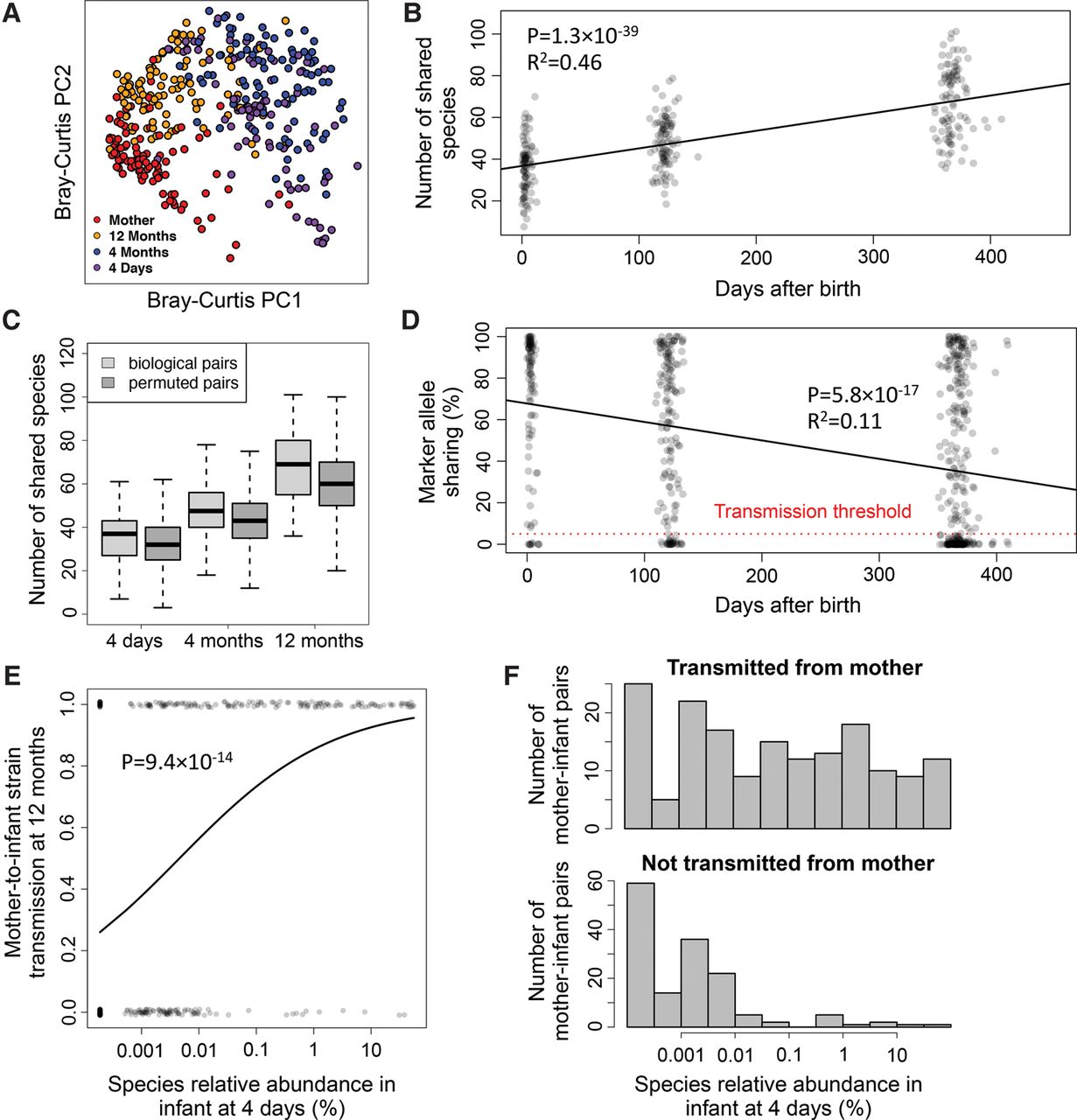
An increase in shared species but a decrease in shared strains over time between stool metagenomes from mothers and their infants. (A) Principal coordinate analysis of Bray-Curtis dissimilarity between species relative abundance profiles of stool samples from mothers and infants at 4 d, 4 mo, and 12 mo following birth. Species composition of infant microbiomes is most similar to mothers at 12 mo. (B) The number of shared species increases over time between mothers and their own infants. (C) This pattern for biological mother–infant pairs is similar to that of unrelated mothers and infants (permuted pairs). (D) In contrast, marker allele sharing decreases over time between mothers and their infants for shared species with greater than 10× sequencing coverage, indicating highest strain similarity at 4 d. Allele sharing is defined as the percentage of marker alleles in the mother that are found in the infant. The horizontal red dotted line indicates the 5% marker allele threshold used for defining vertical transmission events. (E) Early colonizing species are transmitted vertically, whereas late colonizing species are not. The horizontal axis indicates the relative abundance of bacterial species at 4 d. The vertical axis indicates whether a strain of the species was transmitted from the mother (y = 1) or not (y = 0) at 12 mo. The curve is a logistic regression fitted to data points. (F) Histograms indicate the distribution of relative abundance at 4 d for strains that were transmitted and not transmitted from an infant's mother.



