


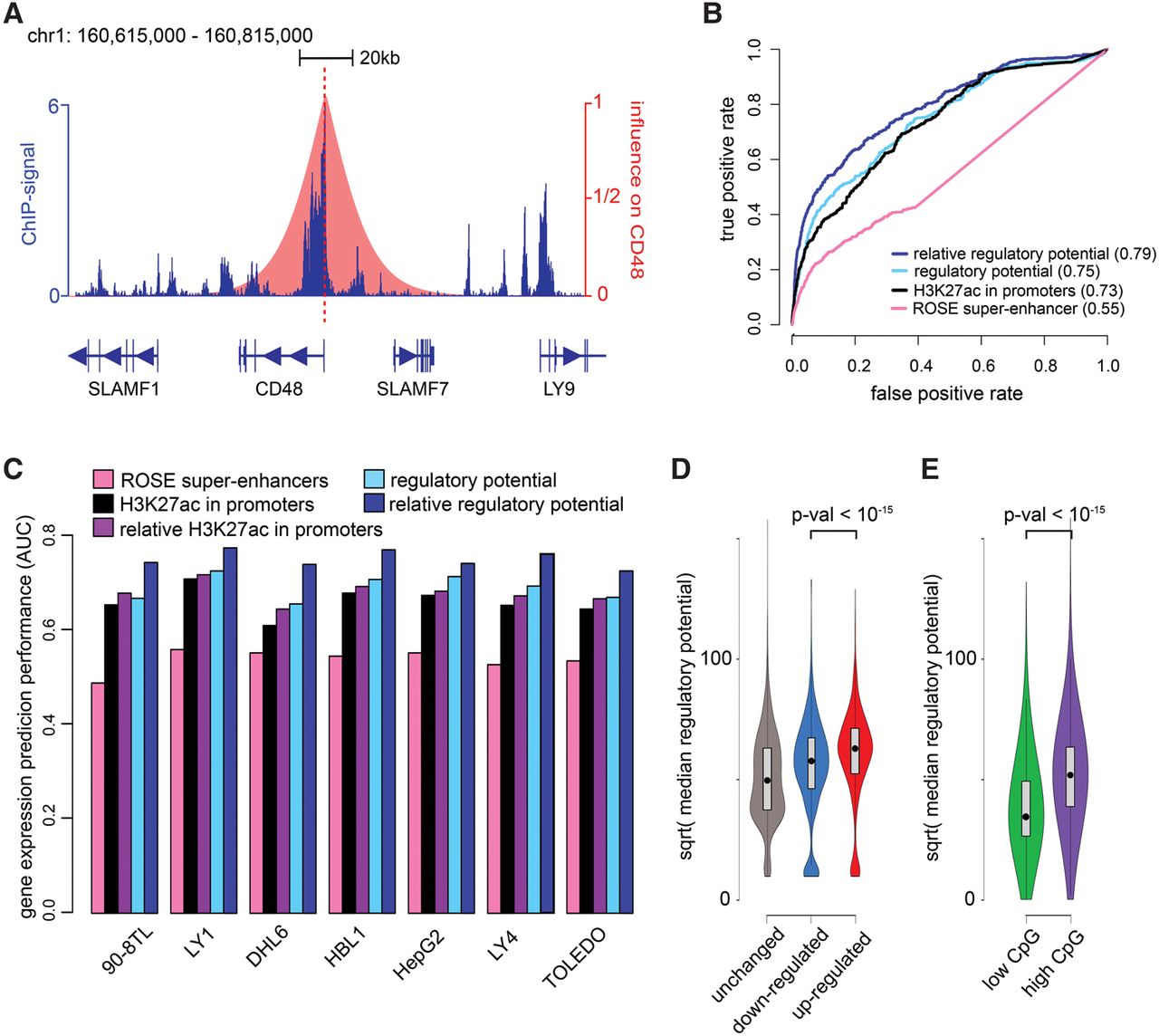
Regulatory potential is predictive of BET-inhibited differential gene expression. (A) The H3K27ac regulatory potential of a gene (in this instance, CD48) is the sum of H3K27ac ChIP-seq reads weighted by a function (pink) that decreases with distance from the transcription start site. All H3K27ac signal is included, irrespective of whether the signal falls within annotated exons, introns, or promoters. (B) Receiver-operator characteristic (ROC) curves show the H3K27ac regulatory potential performs better than the ROSE superenhancer based approach in the identification of genes down-regulated by the BET-inhibitor JQ1 in the diffuse large B-cell lymphoma (DLBCL) derived cell line LY1. Areas under the ROC curves are shown in parentheses. The relative regulatory potential, defined as the ratio of the regulatory potential to the median regulatory potential across all compendium samples, performs consistently better than the other approaches. H3K27ac ChIP-seq read counts in a 2-kb promoter region centered on the transcription start site performs better than superenhancers but not as well as the regulatory potential based methods. (C) The area under the ROC curve performance summaries of the regulatory potential, relative regulatory potential, promoter-based approach, and ROSE superenhancers in five DLBCL cell lines, one liver cancer cell line (HepG2), and one malignant peripheral nerve sheath tumor cell line (90-8TL), are consistent with the result observed in LY1. (D) The distribution of median regulatory potentials across all H3K27ac ChIP-seq samples varies between JQ1 up-, down-, and nonregulated genes. The median regulatory potential of JQ1 up-regulated genes is higher than the rest (Wilcoxon rank-sum test P-value < 10−15), indicating that these genes are likely to be constitutively expressed across a variety of cell types. (E) The median regulatory potential is associated with the CpG/CG ratio of gene promoters. The high CpG genes tend to have the higher median regulatory potentials (Wilcoxon rank-sum test P-value < 10−15).


