


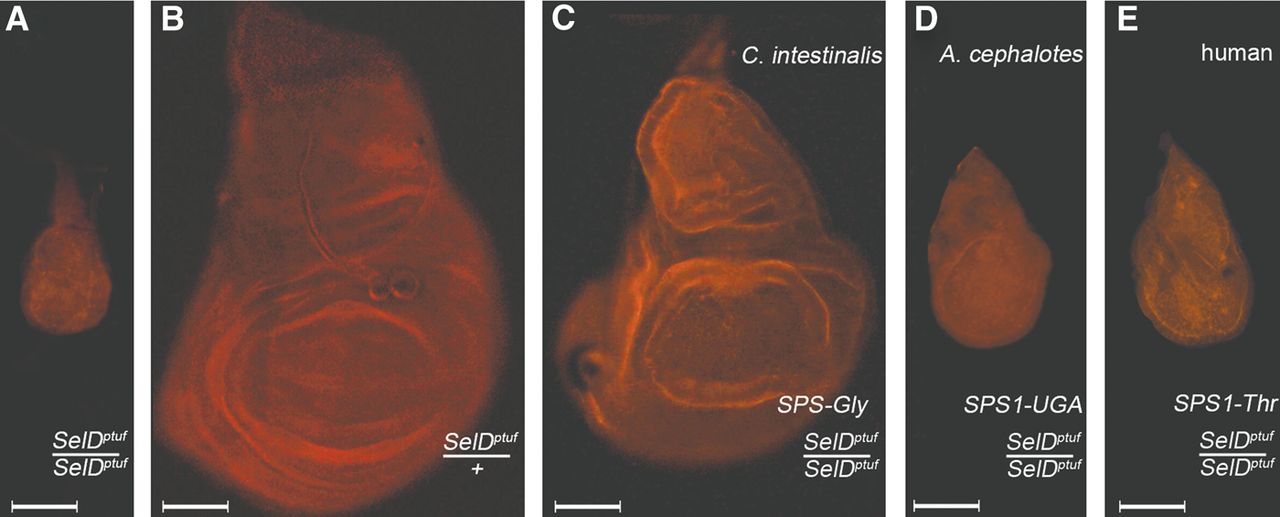
Rescue of the Drosophila melanogaster SPS1 mutant by heterologous SPS1 proteins. All images show wing imaginal discs dissected from larvae with the indicated constructs and genotypes. (A,B) The SPS1 mutant flies (SelDptuf/SelDptuf) result in defects in the whole organism, but can be easily monitored in the wing imaginal disc epithelia; the homozygous condition (A) strongly impairs size and morphology, whereas the heterozygous (B) is very similar to the wild-type condition. (C–E) The severe homozygous SelDptuf/SelDptuf phenotype is partially rescued by ubiquitous expression of heterologous SPS1 proteins. (C) SelDptuf/SelDptuf mutants with C. intestinalis SPS-Gly. (D) SelDptuf/SelDptuf mutants with A. cephalotes SPS1-UGA. (E) SelDptuf/SelDptuf mutants with human SPS1-Thr. (Scale bars) 50 µm.



