


Cover image
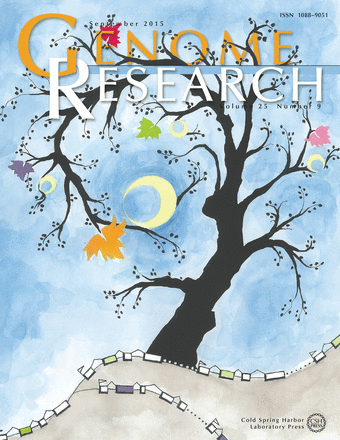
Selenoproteins are a class of proteins that incorporate selenocysteine, a nonstandard amino acid analogous to cysteine, but containing the essential trace element selenium (from Greek σελήνη selene meaning “Moon”) instead of sulfur. In this issue, a study illustrates the evolution of the selenophosphate synthetase genes across prokaryotes and eukaryotes. The selenoprotein gene SPS2 duplicated in several metazoan lineages independently, generating recurrently a novel protein (SPS1) in which Sec was substituted with an amino acid other than cysteine (e.g., arginine in insects, threonine in vertebrates, glycine in ascidians). The figure depicts the selenoprotein genes SPS2 (moons) paired with their paralogous SPS1 (leaves, colored to indicate different Sec substitutions) emerged in various branches of the metazoan tree of life. At the bottom, an event of gene duplication and subfunctionalization is represented, with the duplicated genes then following on separate evolutionary trails. (Cover illustration in acrylic paint on paper by Milena Biolcati Rinaldi, with biological concepts by Marco Mariotti. [For details see Mariotti et al., pp. 1256–1267.])

