


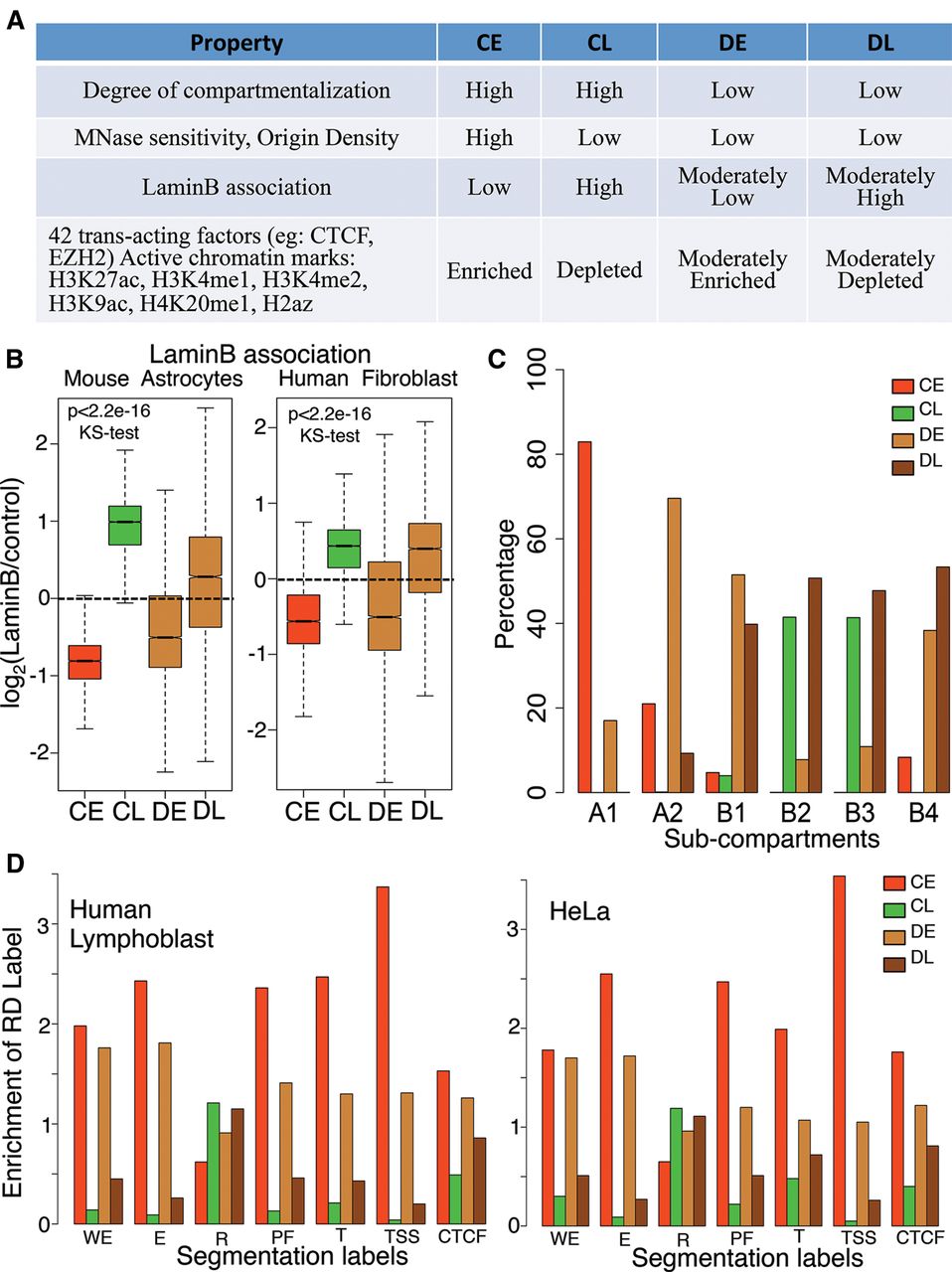
Developmentally regulated regions have different organizational principles. (A) Table comparing chromatin features between constitutive early and late (CE, CL) and developmental RDs that are either early (DE) or late (DL) in the particular cell type analyzed for each respective chromatin feature (Supplemental Table 3). (B) Lamin B association for constitutive early/late and developmental early/late RDs. (C) Distribution of constitutive early/late and developmental early/late RDs within the six subcompartments defined by Hi-C data in GM12878 (Rao et al. 2014). (D) Segway/ChromHMM analysis of human lymphoblast (GM12878) and HeLa cells showing the enrichment of seven chromatin labels within constitutive early/late and developmental early/late RDs. (WE) Weak enhancer, (E) predicted enhancer, (R) predicted repressed regions, (PF) promoter flanking region, (T) predicted transcribed regions, (TSS) predicted promoter region including TSS, (CTCF) CTCF enriched element. Note that in all cases, the properties of developmental domains are less distinct and less dependent on their replication time than constitutive domains.



