


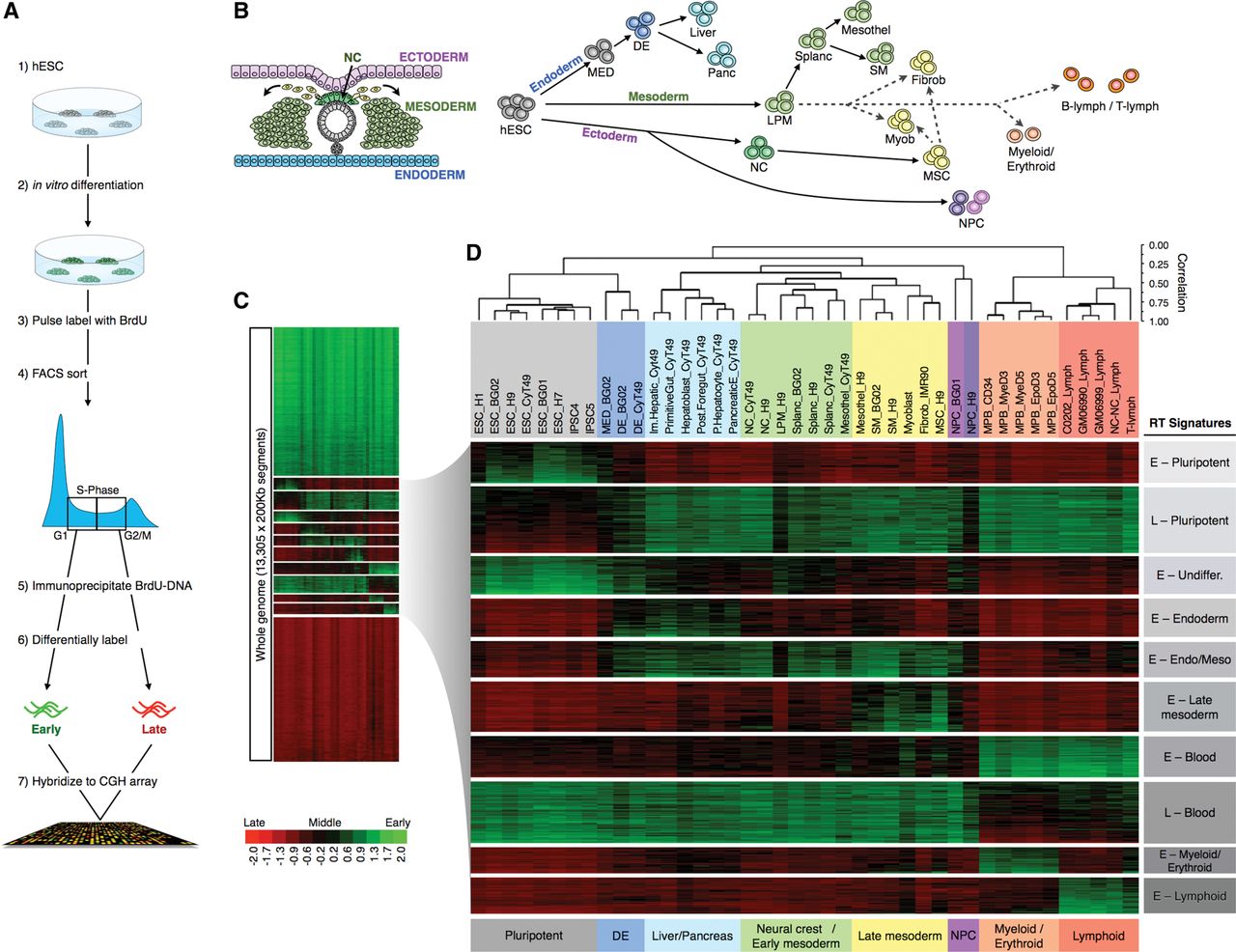
Genome-wide RT patterns are lineage specific. (A) Genome-wide profiling of RT protocol. (B) Schematic diagram showing the three germ layers and the neural crest during the early stages of human development and differentiation pathways of the distinct cell types analyzed. Solid arrow lines depict the in vitro differentiation pathways of the distinct cell types from hESCs; dashed arrows depict the embryonic origin of the cell types not derived from hESCs (primary cells and cell lines). (C) RT changes across the different lineages. The whole genome was divided into 13,305 windows of 200 kb and their average RT ratios [=log2(Early/Late)] were compared across the human lineages. Heat map shows the RT ratios. (D) Hierarchical clustering of the distinct human lineages and k-means of switching 200-kb windows. Switching 200-kb segments were identified as being early replicated in at least one cell type (RT log2 ratio ≥+0.3) and late replicated in at least one other cell type (RT log2 ratio ≤−0.3) and analyzed by hierarchical clustering of the cell types. Branches of the dendrogram were constructed based on the correlation values between distinct cell types (distance = correlation value −1). A correlation threshold of >0.5 was used to color label the major groups of cell types. Specific clusters of cell types are indicated at the bottom: pluripotent, definitive endoderm, liver and pancreas, neural crest and early mesoderm, late mesoderm and fibroblasts, NPC, myeloid, and lymphoid. k-means clustering of switching segments defined the RT signatures labeled in gray boxes. The sex chromosomes were removed from the analysis to discard gender differences. (NC) neural crest; (MED) mesendoderm; (DE) definitive endoderm; (LPM) lateral plate mesoderm; (Splanc) splanchnic mesoderm; (Mesothel) mesothelium; (SM) smooth muscle; (Myob) myoblasts; (Fibrob) fibroblasts; (MSC) mesenchymal stem cells; (NPC) neural progenitor cells.


