


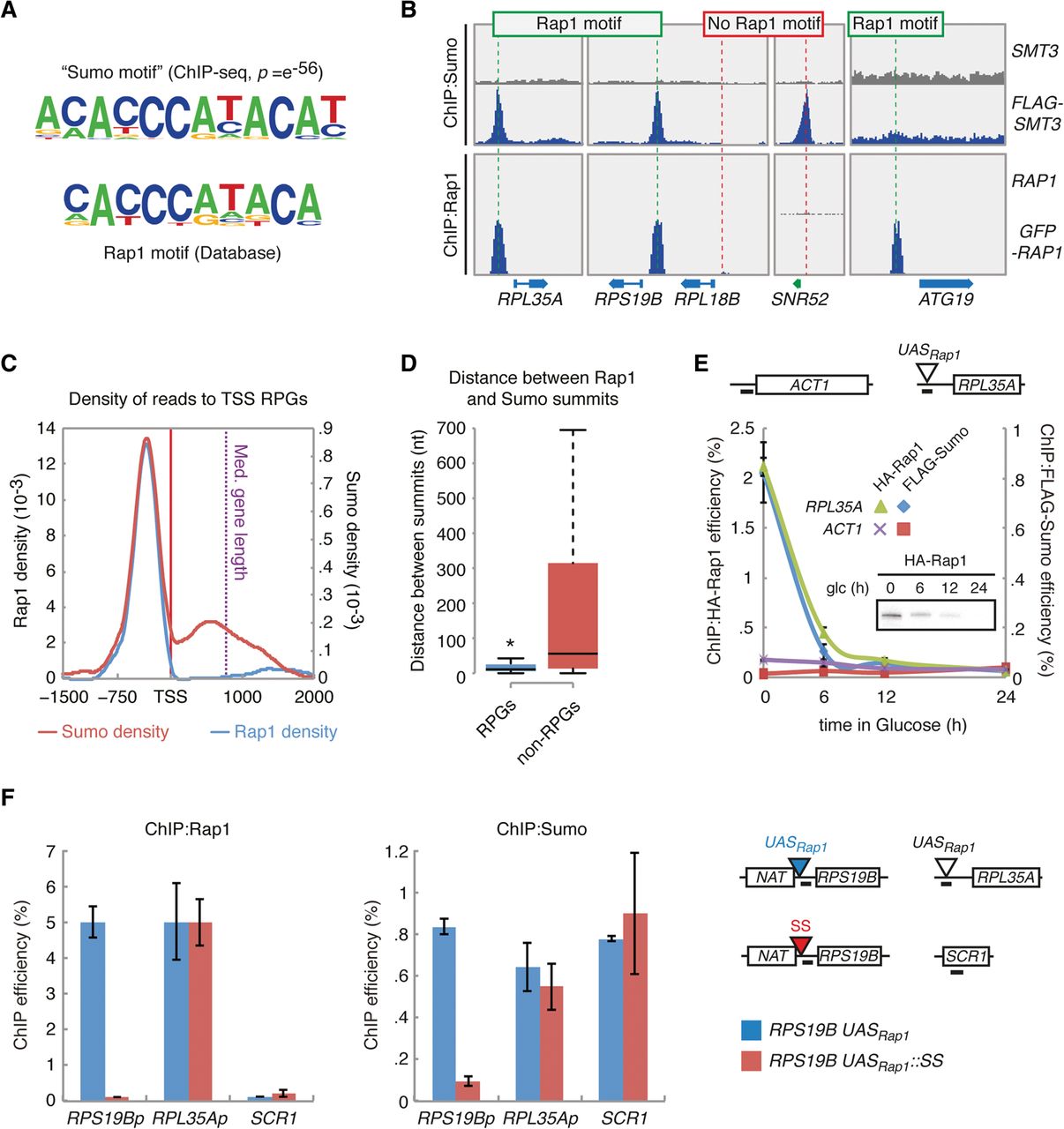
Sumoylation at RPG promoters requires the presence of Rap1. (A) The Sumo consensus motif is highly similar to the Rap1 DNA binding motif. (B) Snapshots of the Rap1 and Sumo ChIP-seq experiments. (C) Perfect overlap between Sumo peaks and Rap1 peaks at RPG promoters. (D) Box plot showing the nucleotide (nt) distance between Sumo and Rap1 peaks at RPGs and non-RPGs. Median values are 11 and 55.5 nt for RPGs and non-RPGs, respectively (Mann-Whitney U test; W = 3823, P = 3.837 × 10⁻⁵). (E) Recruitment of Sumo depends on Rap1. Cells expressing Rap1 from the GAL1 promoter were grown to log phase in the presence of galactose, washed, and incubated in glucose. Levels of endogenous HA-Rap1 and FLAG-Sumo at the RPL35A promoter were analyzed by ChIP. Primer pair locations are indicated above the graph. (Inset) Level of Rap1 by Western blotting. Error bars, SEM. (F) The Rap1 binding site at the RPS19B promoter was either left intact (RPS19B_UASRAP1) or replaced with scrambled sequence (RPS19B_UASRAP1SS; see Supplemental Methods for construction details). Insertion of scrambled sequence resulted in loss of Rap1 at RPS19B (left panel) and prevented recruitment of Sumo (right panel). Error bars, SEM.



