


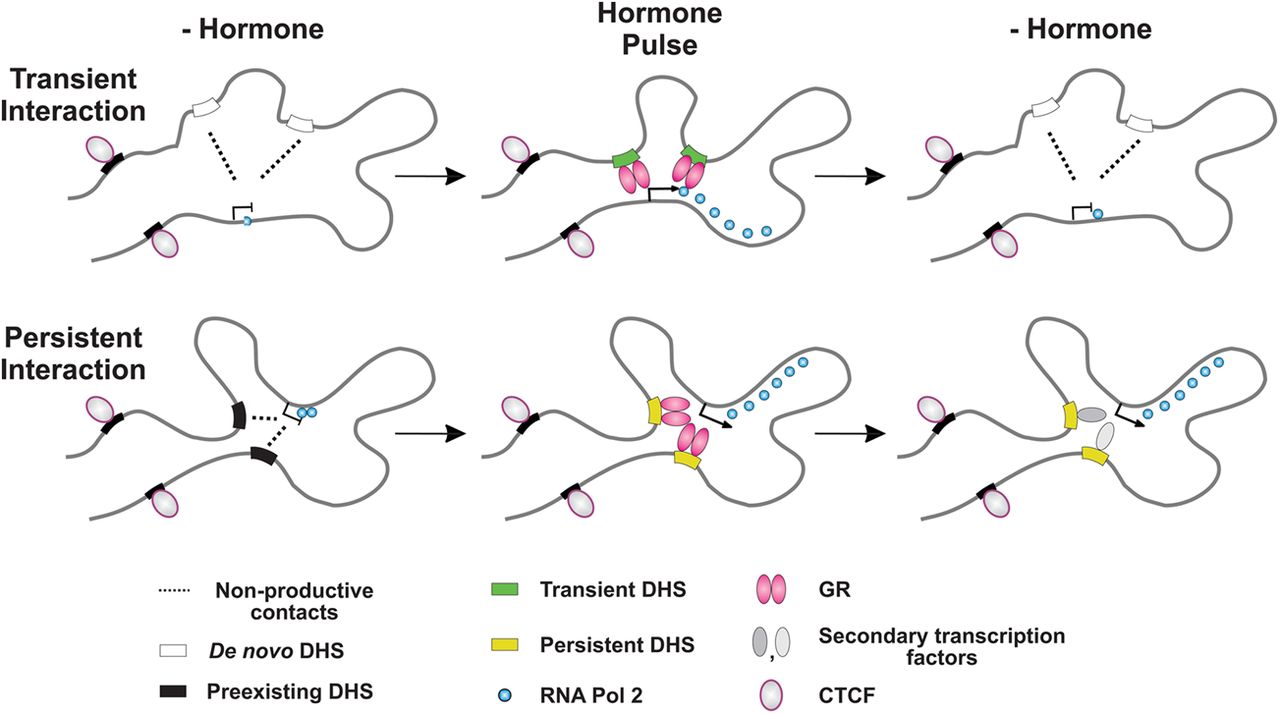
Chromatin accessibility dynamics at distal enhancers impacts the strength of their long-range interactions with gene targets and contributes to gene regulation. (Top) A schematic depicting reversible and hormone-dependent long-range interactions between transient, de novo DHSs (similar to DHS5) (Fig. 6) and the promoter of a gene target. The preexisting organization of the locus favors transient, nonproductive interactions between them, even in the absence of corticosterone (-Hormone). However, GR binding to these DHSs upon hormone addition (Hormone Pulse) facilitates their retention at the TSS resulting in higher interaction frequency. This allows an increased Pol II loading and promotes a hormone-dependent gene transcription. (Bottom) A schematic depicting prolonged interactions of preexisting, but still hormone-responsive, DHSs with a gene target. In contrast to the transient DHSs, the accessibility of the persistent DHSs and the interaction frequency between them and the gene remain elevated even upon hormone withdrawal. We envision the involvement of opportunistic factor(s) binding to these DHSs and sustaining their hypersensitivity as well as gene transcription even after hormone withdrawal.



