


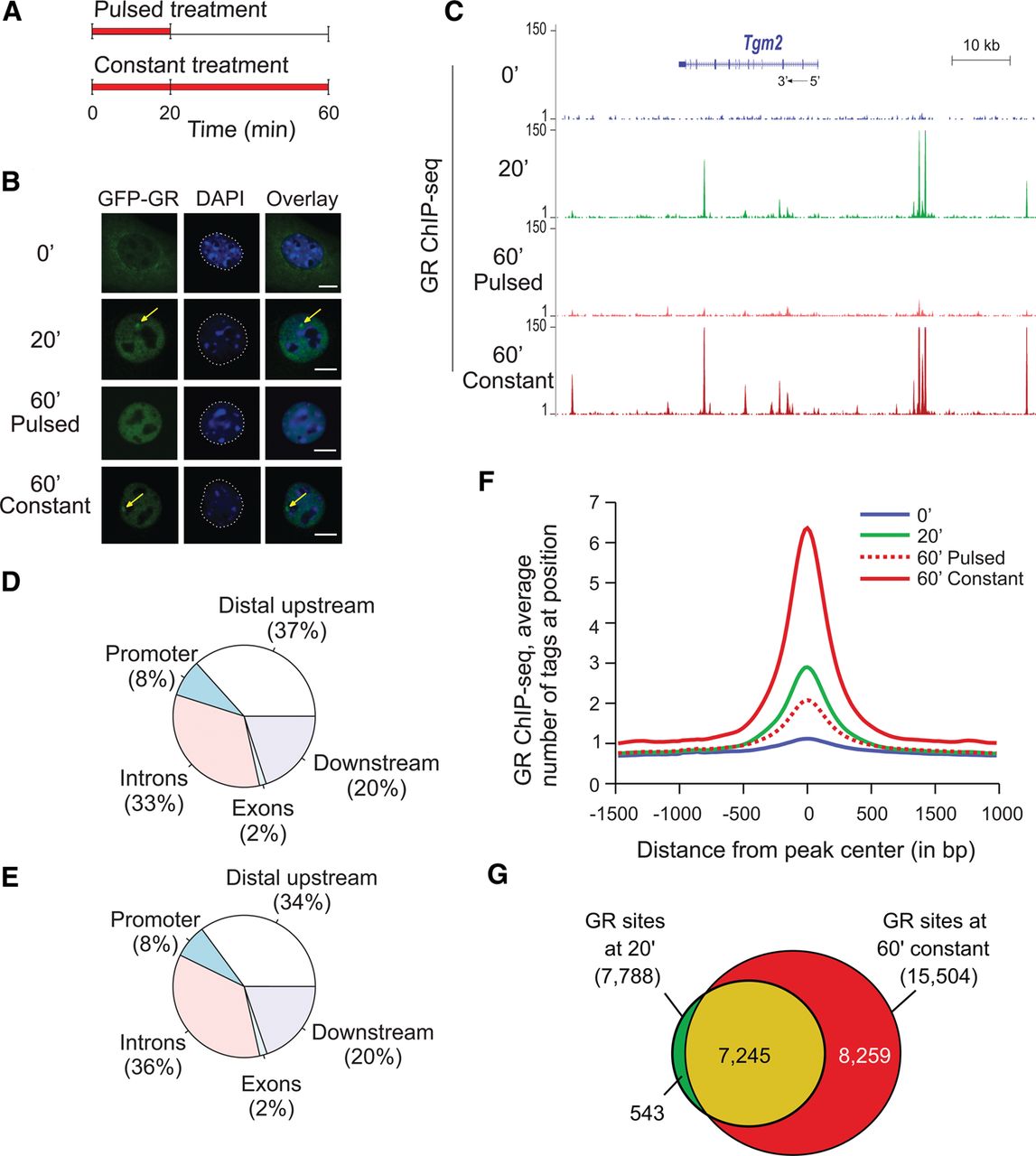
Divergent GR binding responses to pulsed (ultradian) and continuous hormone stimulation. (A) Schematic representation of pulsed and continuous hormone stimulation. (B) GFP-GR association with the MMTV promoter array in the presence of hormones (yellow arrows) and its rapid redistribution upon hormone withdrawal is the basis for the cyclic GR interactions with regulatory elements in response to naturally occurring hormone level fluctuations. Continuous stimulation with corticosterone (60 min constant) results in a persistent GR enrichment at the array (yellow arrows). (Scale bar) 5 µm. (C) GR enrichment at sites situated upstream and downstream, as well as in the body of a GR regulated gene, Tgm2, (20 min sample and 60 min constant sample). (D,E) Genomic location of the GR peaks at 20 and 60 min of constant hormone stimulation did not differ significantly. (F) An aggregate plot demonstrating that GR peaks diminish upon hormone washout (60′ pulsed condition) while increasing in tag density upon continuous hormone stimulation (60 min constant condition). (G) GR interaction with the GREs throughout the genome is time-dependent with more GR peaks appearing at 60 min continuous hormone stimulation.



