


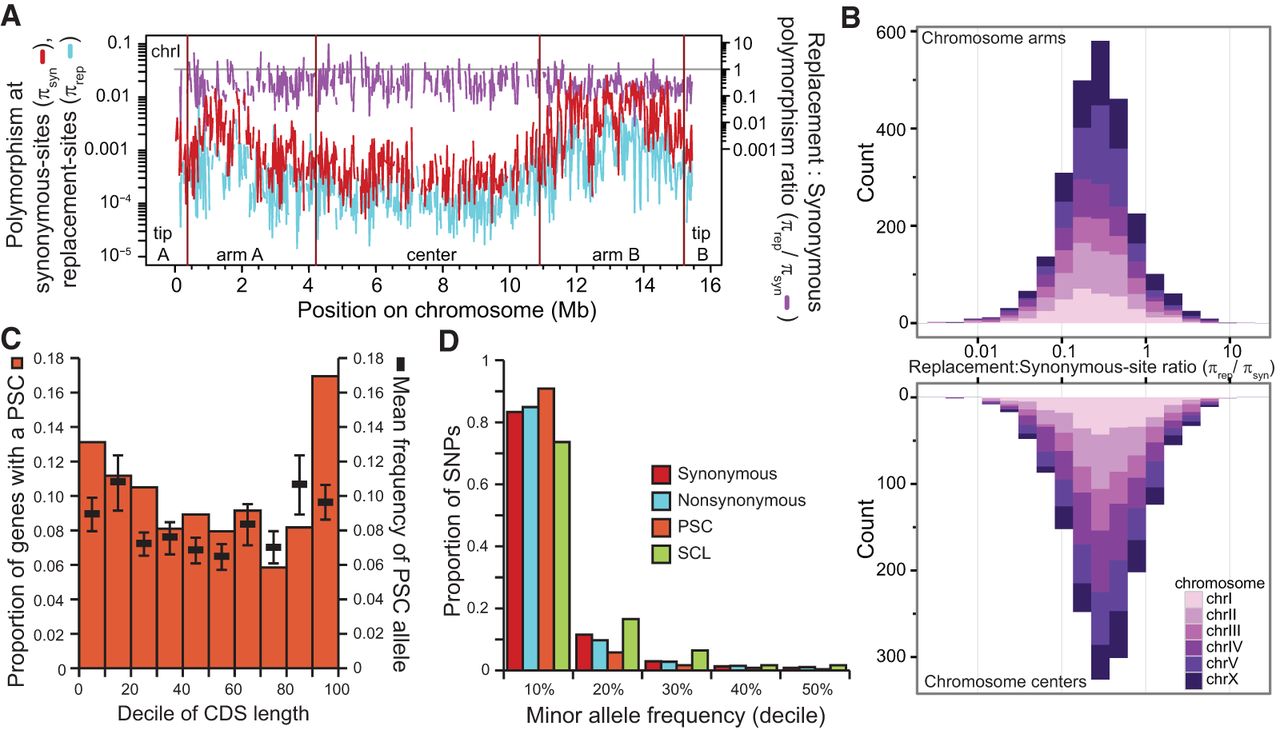
Missense and nonsense mutations are generally deleterious and selected against. (A) Windows of 20 kb sliding along Chromosome I indicate the lower polymorphism at nonsynonymous sites (πrep) than at synonymous sites (πsyn) for Tropical strains (see Supplemental Fig. 10 for all chromosomes). A slight trend of elevated πrep/πsyn in chromosome centers (B) is indicative of less effective selection in purging deleterious mutations from these regions of high linkage (median of 20-kb windows on arms πrep/πsyn = 0.259; centers πrep/πsyn = 0.290; Wilcoxon χ2 = 15.84; P < 0.0001). The stacked histogram of πrep/πsyn in B shows the cumulative abundance of 20-kb windows with a given bin of πrep/πs across the six chromosomes, partitioned into chromosome arm and center domains. (C) Distribution of nonsense SNPs along coding sequences (CDS) expressed as percentage of the CDS length. (D) Distribution of the minor allele frequency (MAF) for different classes of SNPs: (red) synonymous; (blue) nonsynonymous; (orange) premature stop codons (PSC); (green) stop codon losses (SCL). PSC SNPs have significantly skewed low MAF values, indicating stronger selective constraints. In contrast, SCL SNPs have significantly higher MAF suggesting misannotation of the reference stop codon or PSC mutations in the reference genome.



