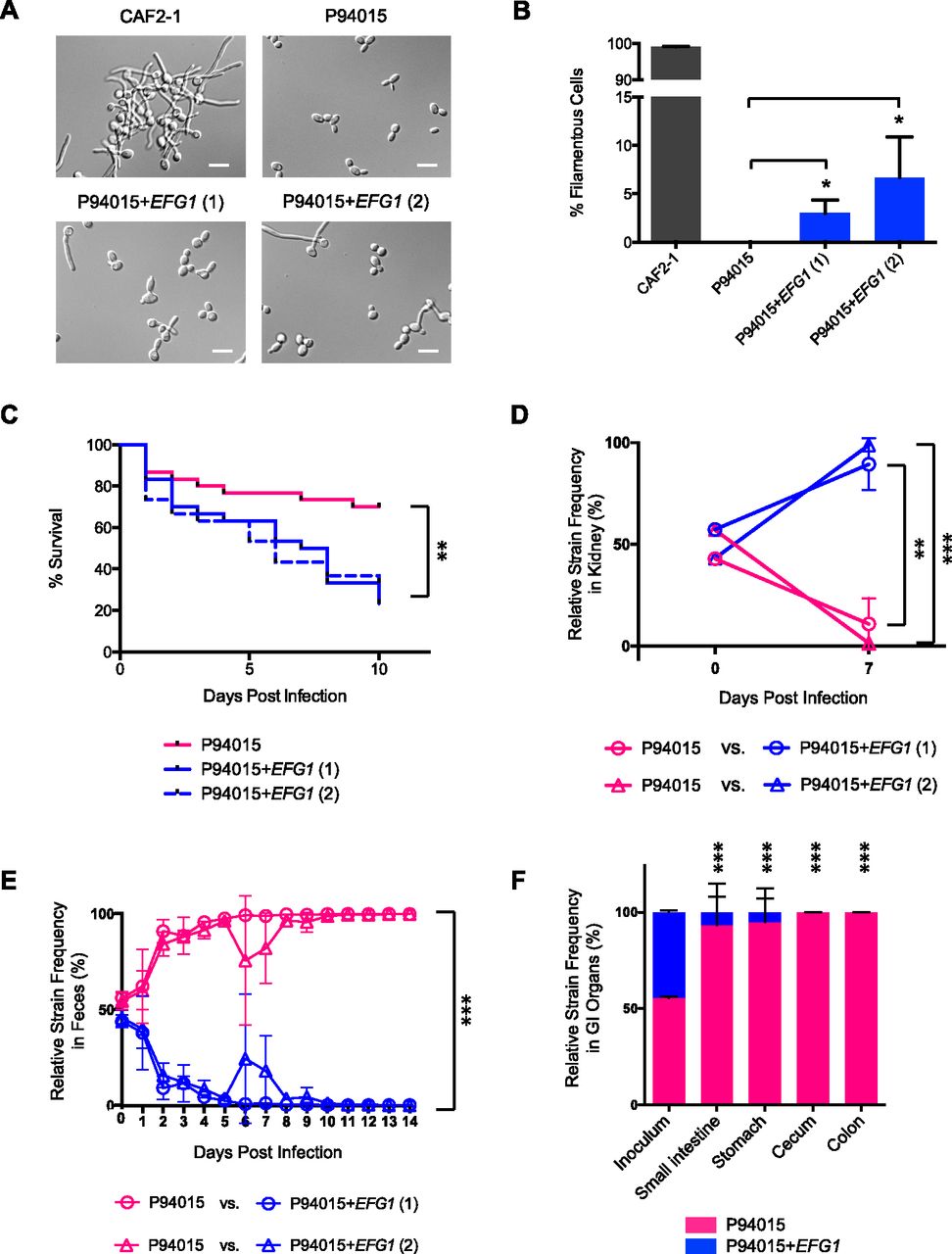
Analysis of native and EFG1-complemented P94015 strains in commensal and pathogenic models of infection. (A,B) Induction of filamentation in SC5314 and P94015 strains in YPD medium supplemented with 10% serum at 37°C. Two independent EFG1-complemented strains are shown: P94015 + EFG1(1) and P94015 + EFG1(2). (C) Survival curves for Galleria mellonella infected with strain P94015 and EFG1-complemented P94015. n = 30 worm per strain, P < 0.01, log-rank Mantel-Cox test. (D) Competition between native P94015 and EFG1-complemented P94015 in a murine model of systemic infection. C. albicans cells were recovered from kidneys after 7 d infection and compared to the inoculum. Data are two independent competition experiments with four mice each. (E) Testing of P94015 or derived strains in a murine model of commensal fitness. C. albicans cells were recovered from fecal pellets each day, and the relative levels of native P94015 or EFG1-complemented P94015 were determined. Error bars, ±SD. n = 3 mice for each competition. (F) Relative levels of P94015 or EFG1-complemented P94015 in gastrointestinal tissues after 2 wk of commensal growth. Error bars, ±SD.