


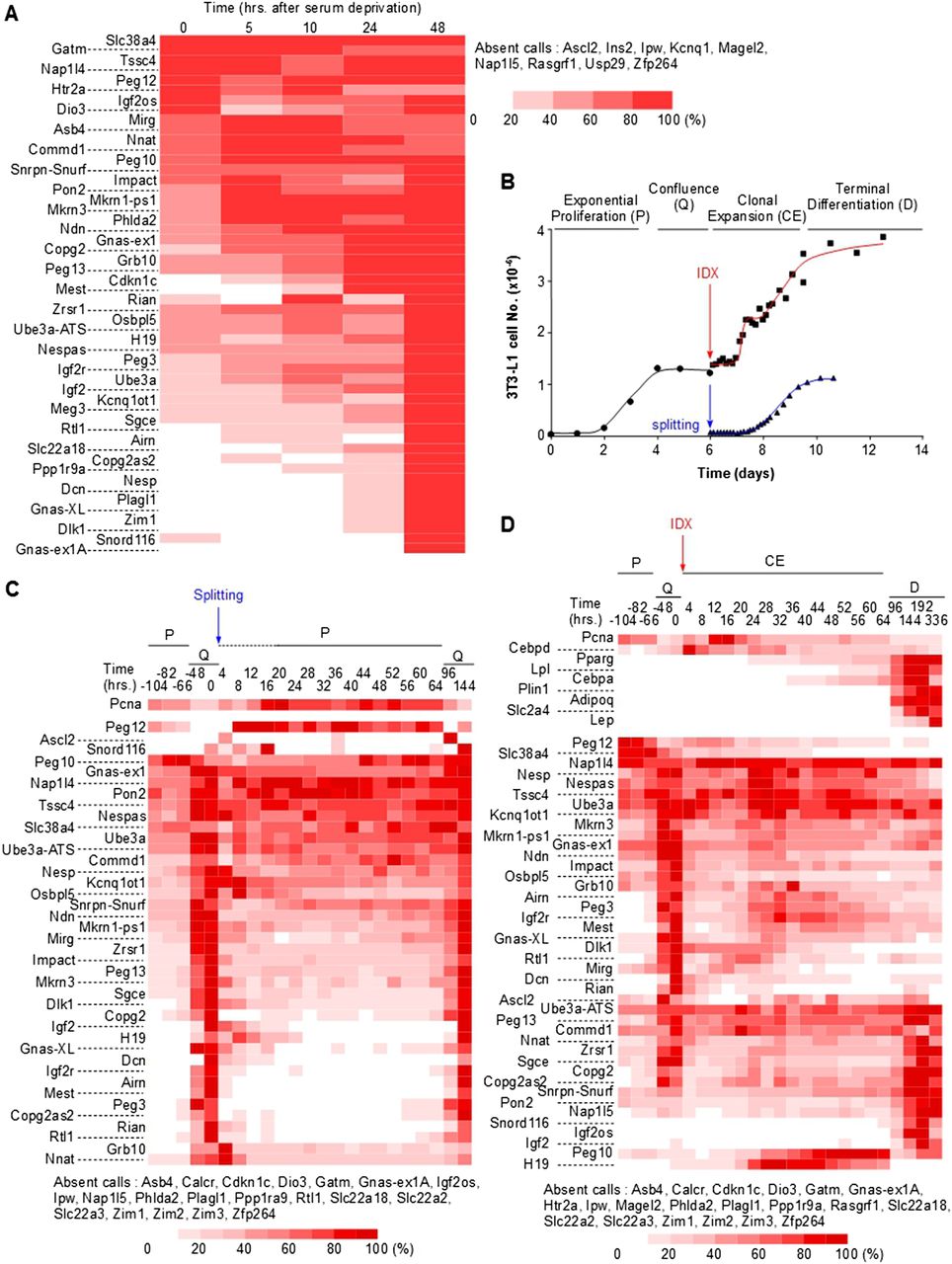
Imprinted genes are coregulated upon cell cycle exit/reentry and differentiation. (A) Heatmap of IG expression levels following serum withdrawal. Exponentially growing mouse embryonic fibroblasts were serum-starved, and expression levels of the indicated IGs were monitored by real-time PCR at the indicated time after serum withdrawal. Data for each IG are expressed as the percentage of the maximal expression levels for that IG. (B) The 3T3-L1 adipogenic differentiation model. 3T3-L1 preadipocytes were grown exponentially (P, proliferation) until they reached confluence (Q, quiescence) following contact inhibition. Forty-eight hours later, they were either split and resumed exponential growth, or induced to differentiate following addition of IDX. In the latter condition, induced preadipocytes resumed proliferation during the clonal expansion phase (CE, clonal expansion), and eventually exited the cell cycle and differentiated (D, differentiation). (C) Heatmap of IG expression levels during 3T3-L1 exponential growth and quiescence. 3T3-L1 preadipocytes were grown as described in B. Expression levels of the indicated IGs were monitored and depicted as in A. Pcna is a marker of cell proliferation. (D) Heatmap of IG expression levels during 3T3-L1 adipogenic differentiation. 3T3-L1 preadipocytes were grown as in B. Expression levels of the indicated IGs were monitored and represented as in A. Cebpd, Pparg, Lpl, Cebpa, Plin1, Adipoq, Slc2a4, and Lep are markers of early and late adipogenic differentiation.



