


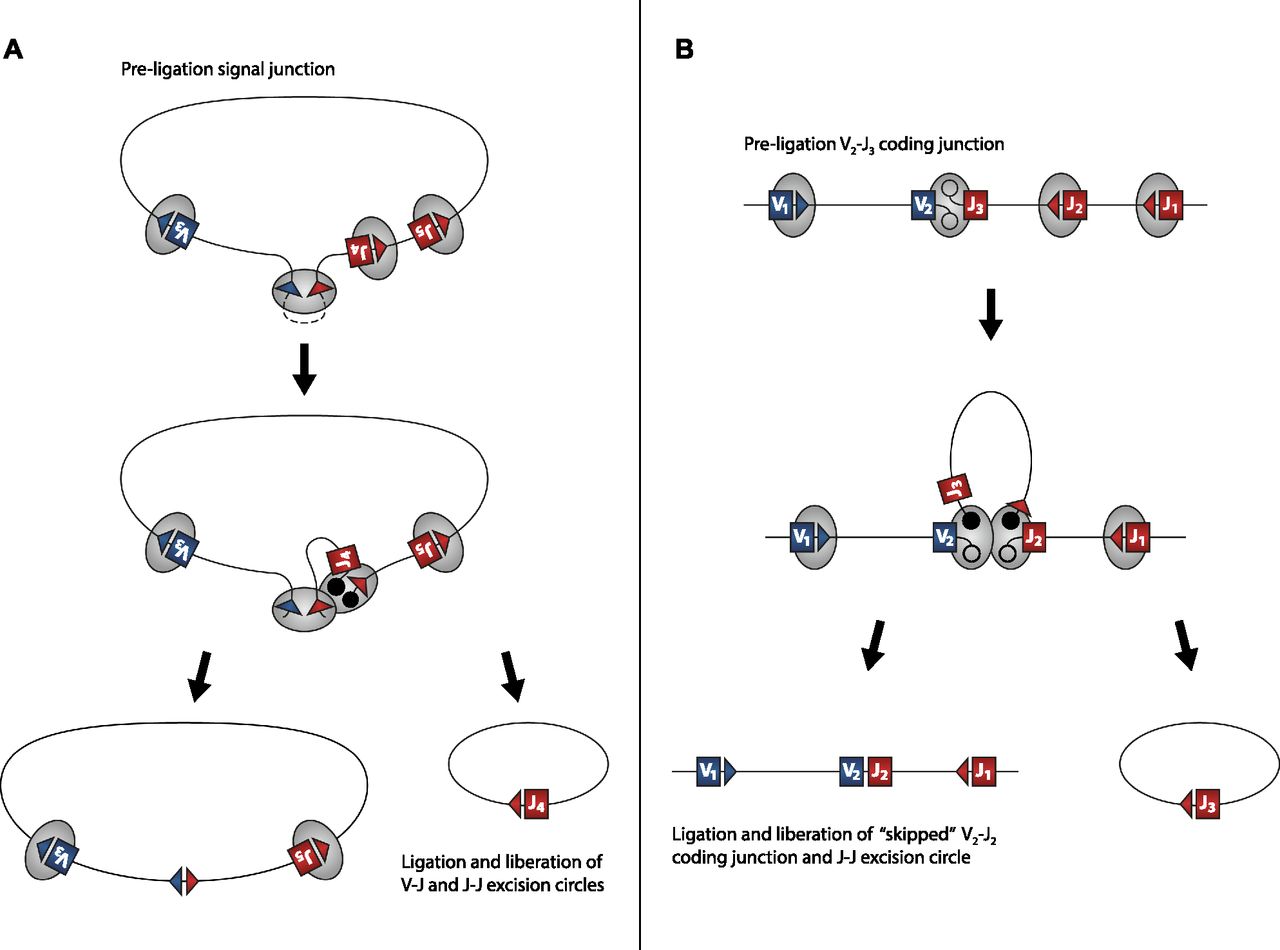
Alternative models of J-J EC production. (A) V2-J3 recombination (see Fig. 1) forms an excision circle pre-ligation intermediate containing variable (blue box) and joining (red box) gene segments with RAG complexes (gray circles) bound at multiple RSS sites (red and blue triangles). Additional synapsis and dsDNA cleavage occurs between an internal J segment RSS and RAG complex bound to either unresolved signal ends or a fully ligated signal junction (as denoted by a dashed line). V-J signal and J-J hybrid junction ends (filled circles) are resolved and liberated as independent ECs. (B) V2-J3 recombination forms a coding junction pre-ligation intermediate with hair-pinned ends (gray circles) containing variable (blue box) and joining (red box) gene segments with RAG complexes (gray circles) bound at multiple RSS sites (red and blue triangles). Additional synapsis and dsDNA cleavage occurs between the RAG complex bound to the unresolved coding end and the flanking J2 segment RSS. The initial V2-J3 coding junction is “skipped,” and a V2-J2 coding junction is formed along with a J-J hybrid junction containing EC.


