


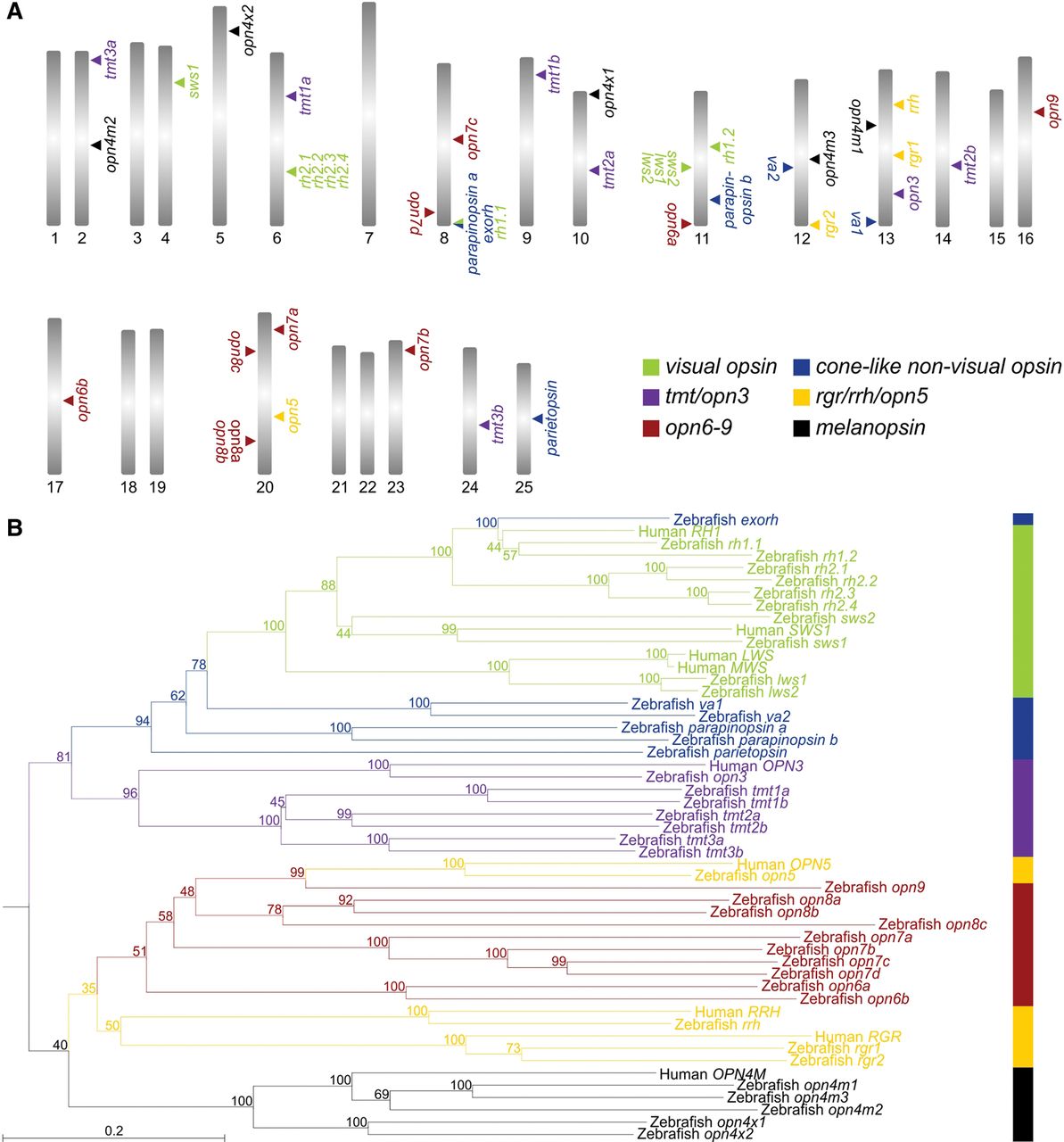
Opsin diversity in the zebrafish genome. (A) Mapping of opsins shows that the zebrafish genome contains 42 distinct pigment genes across 17 chromosomes. (B) Phylogenetic analysis of pigment genes in human (Homo sapiens) and zebrafish (D. rerio) genomes, showing the presence of 10 novel opsin genes. Outgroups are not shown. The scale bar indicates the number of nucleotide substitutions per site and the degree of internal branching is expressed as a percentage at each node. For a more extensive tree and GenBank accession numbers (KT008391–KT008432), including ZFIN (http://www.zfin.org) gene nomenclature where appropriate, please see Supplemental Figure S1. Opsin classes are subdivided into six main groups that contain visual opsins (green), cone-like nonvisual opsins (blue), opn3/tmt opsins (purple), rgr/rrh/opn5 opsins (yellow), opn4 opsins (black), and the new opsins (red). Specifically, these are subdivided into extra-ocular rhodopsin (exorh), rhodopsin-like-1 (rh1) rod opsin, rhodopsin-like-2 (rh2) cone opsin, short-wavelength-sensitive-2 (sws2) cone opsin, short-wavelength-sensitive-1 (sws1) cone opsin, long-wavelength-sensitive (lws) cone opsin, vertebrate ancient (va) long opsin, parapinopsin, parietopsin, encephalopsin/panopsin (opn3), teleost multiple tissue (tmt) opsin, neuropsin (opn5), novel opsins (opn6, opn7, opn8, and opn9), retinal pigment epithelium (RPE) rhodopsin homolog (rrh; also known as peropsin), RPE retinal G protein receptor (rgr), mammalian-like melanopsin (opn4m), and Xenopus-like melanopsin (opn4x).



