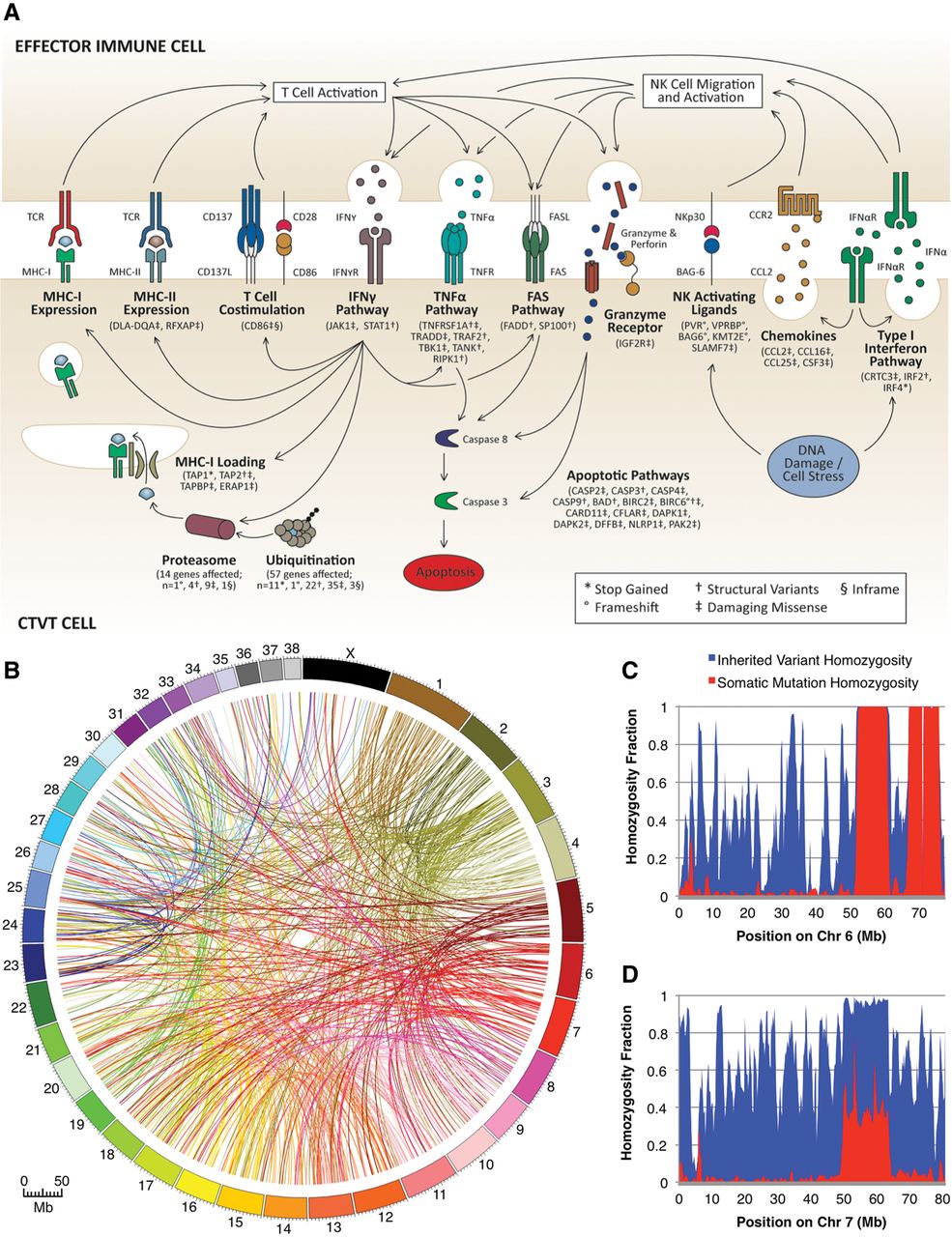
Somatic mutations shared by both CTVT tumors lend insight into the biology of clonal transmissibility. (A) Somatic mutations impact all aspects of pathways involved in immunosurveillance. (B) Seven hundred twenty-eight chromosome-to-chromosome translocations were shared by both tumors. (C) Recent LOH events are characterized by complete homozygosity of both alleles inherited by the CTVT founder and somatic SNVs, as in this example on Chromosome 6. (D) Older LOH events have elevated inherited SNV homozygosity, but low somatic mutation homozygosity, since SNVs that predate the LOH event are homozygous, but their relative contribution has been diminished by subsequent heterozygous mutations, as observed on Chromosome 7. Plots for all chromosomes can be found in Supplemental Figure S2.