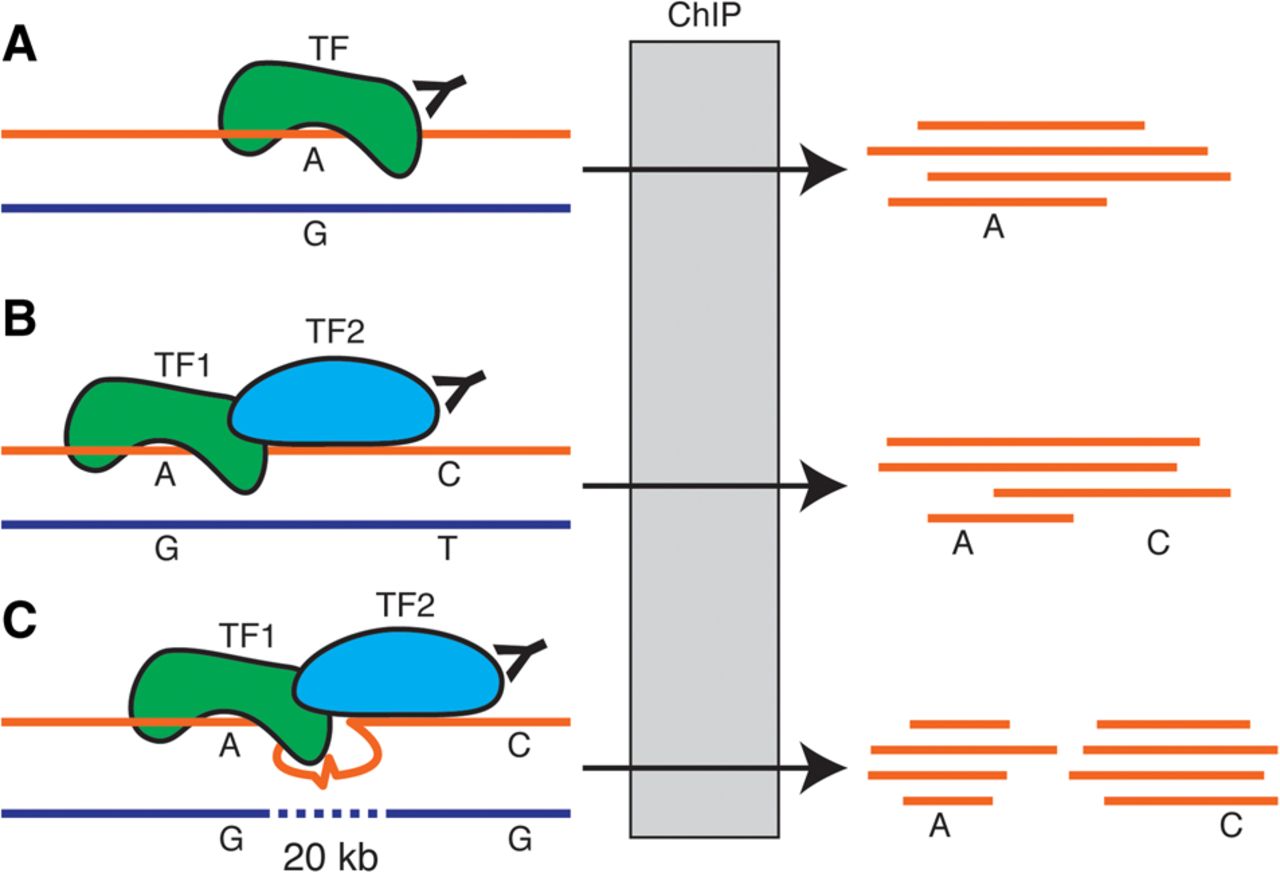
Mechanisms of allele-specific transcription factor occupancy. (A) Local effects occur when a genetic variant directly impacts the ability of a transcription factor to bind DNA. In this example, only the A allele is bound by the transcription factor and recovered by ChIP. (B) Genetic variants may lead to allele-specific binding of entire regulatory complexes. In this example, transcription factor TF1 binds the A but not the G allele. Because TF1 also recruits TF2 to the same regulatory complex, ChIP-seq for TF2 preferentially isolates the A and C alleles even though TF2 does not directly bind either variant. (C) Long-range interactions may also drive distal allele-specific effects. One potential mechanism is that TF1 and TF2 form a regulatory complex via DNA looping. Because occupancy of TF1 influences that of TF2, variants that impact TF1 binding lead to an allele-specific signal for TF2 occupancy.