


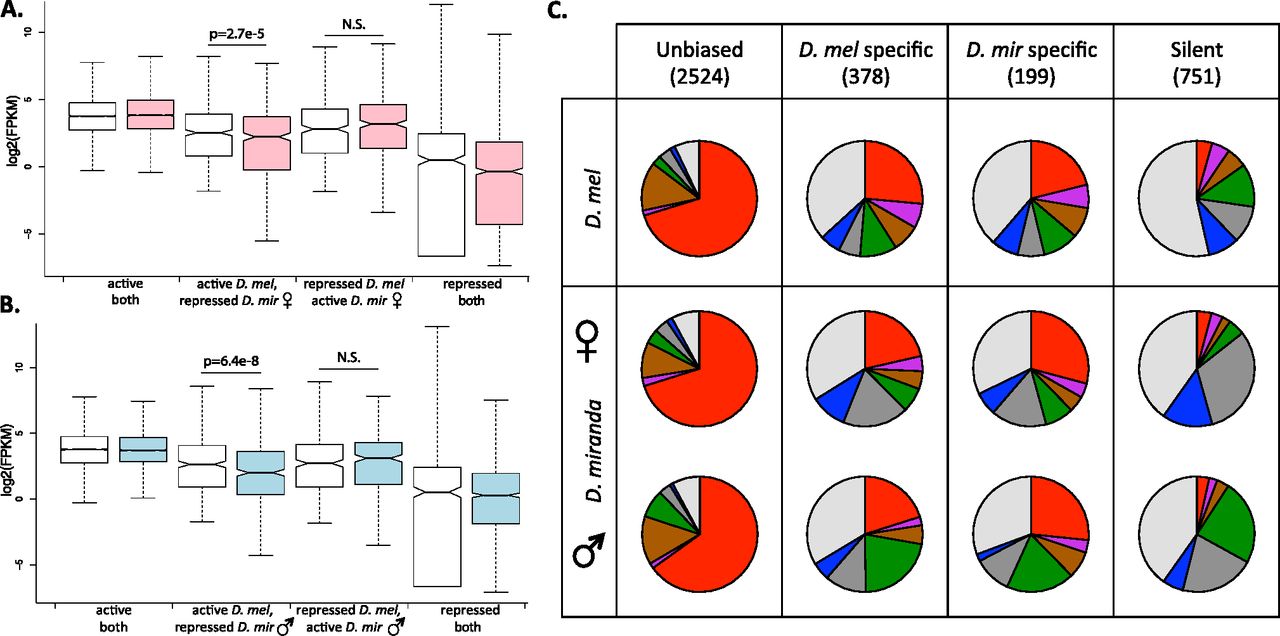
Species-specific chromatin states and gene expression. (A) D. melanogaster (white) and D. miranda female (pink) expression of genes categorized in active chromatin in both species (states 1–3), active in one species but not the other, or in repressive chromatin in both species (states 5–7). Genes in active chromatin in both species are significantly more highly expressed than genes that are in an active state in only one species (P < 2.6 × 10⁻⁶ for all comparisons, Wilcoxon test). (B) Same as A but comparing D. melanogaster with D. miranda male (blue). Genes in active chromatin in both species are significantly more highly expressed than genes in an active state in only one species (P < 3 × 10⁻⁴ for all comparisons, Wilcoxon test). (C) Chromatin states of genes expressed similarly in both species, genes expressed in one species but not the other, and genes not expressed in either species. Only genes with unbiased expression between male and female D. miranda were considered.


