


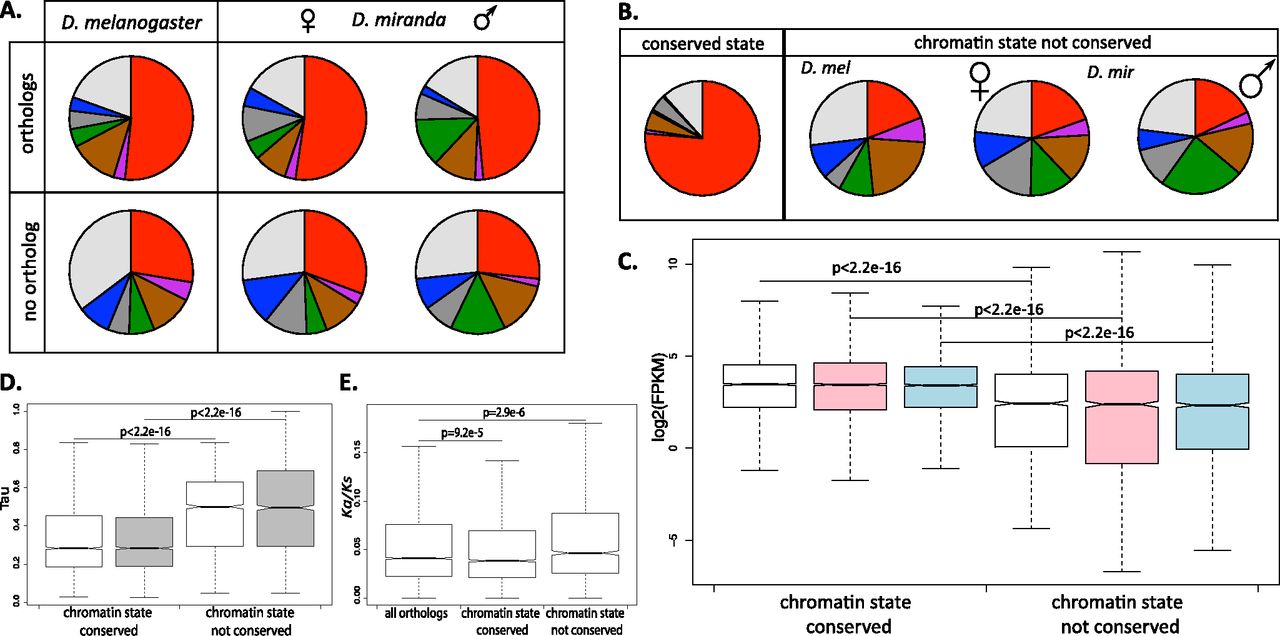
Conservation of chromatin states of genes in D. miranda and D. melanogaster. (A) Chromatin state of orthologous and nonorthologous genes in D. miranda females and males and D. melanogaster. Orthologous genes defined by FlyBase. (B) Chromatin states of orthologous genes whose state is conserved across species and sexes (left), and those whose state is not conserved (right). (C) Expression levels (log2[FPKM]) of orthologous genes with conserved and not conserved chromatin state (D. melanogaster in white, D. miranda males in blue, D. miranda females in pink). (D) Tissue specificity (measured by the tissue-specificity index tau) of genes with conserved and not conserved chromatin state in D. melanogaster (white) and D. miranda (gray). (E) Rates of protein evolution (Ka/Ks) of genes with conserved and not conserved chromatin state between D. melanogaster and D. miranda.


