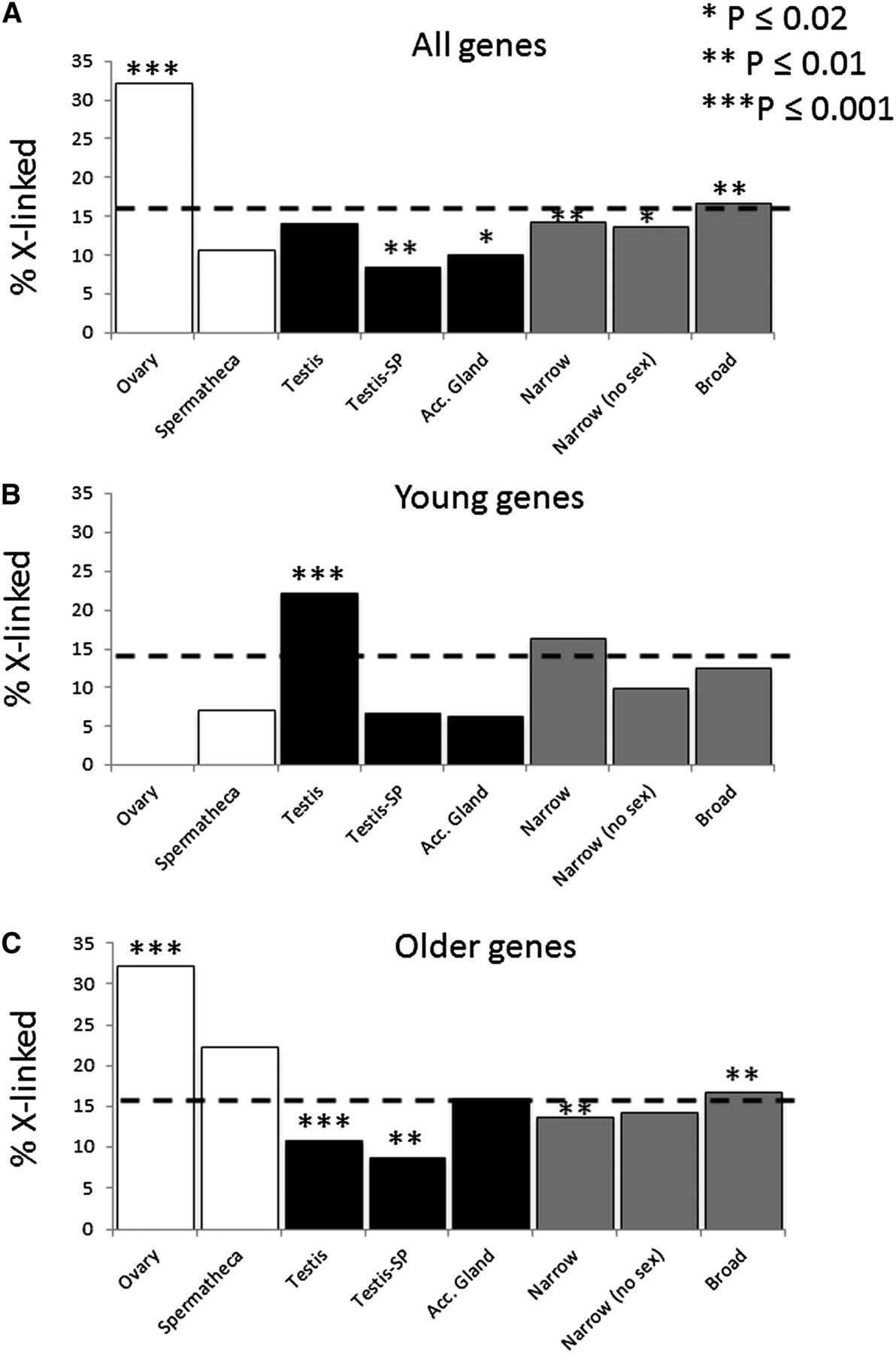
Percentage of D. melanogaster X-linked genes that are broadly and narrowly expressed. Following the methods in Meisel et al. (2012), genes narrowly expressed are also called specific genes (τ > 0.7) in each of four sex-limited tissues, with testis-specific expression and detectable in the sperm proteome (testis-SP), narrowly expressed in any of 14 tissues (narrow), narrowly expressed in one of 10 non-sex-limited tissues (no sex), or broadly expressed genes (τ ≤ 0.4). Percentage of X-linked in the genome are shown by dashed lines. Significant deviations (Fisher's exact test) are indicated: (***) P < 0.001; (**) P < 0.01; (*) P < 0.02. All X-linked genes (A) were separated according to their evolutionary age. New (B) and old (C) genes were defined according to Zhang et al. (2010a), in which old genes are at least as old as the split between Sophophora and Drosophila subgenera. At first (A), there is no paucity of testis-specific genes in the X chromosome. However, opposite patterns are found for old and new genes: Although old testis-specific genes are underrepresented (C), new testis-specific genes are found in excess in the X chromosome (B).