


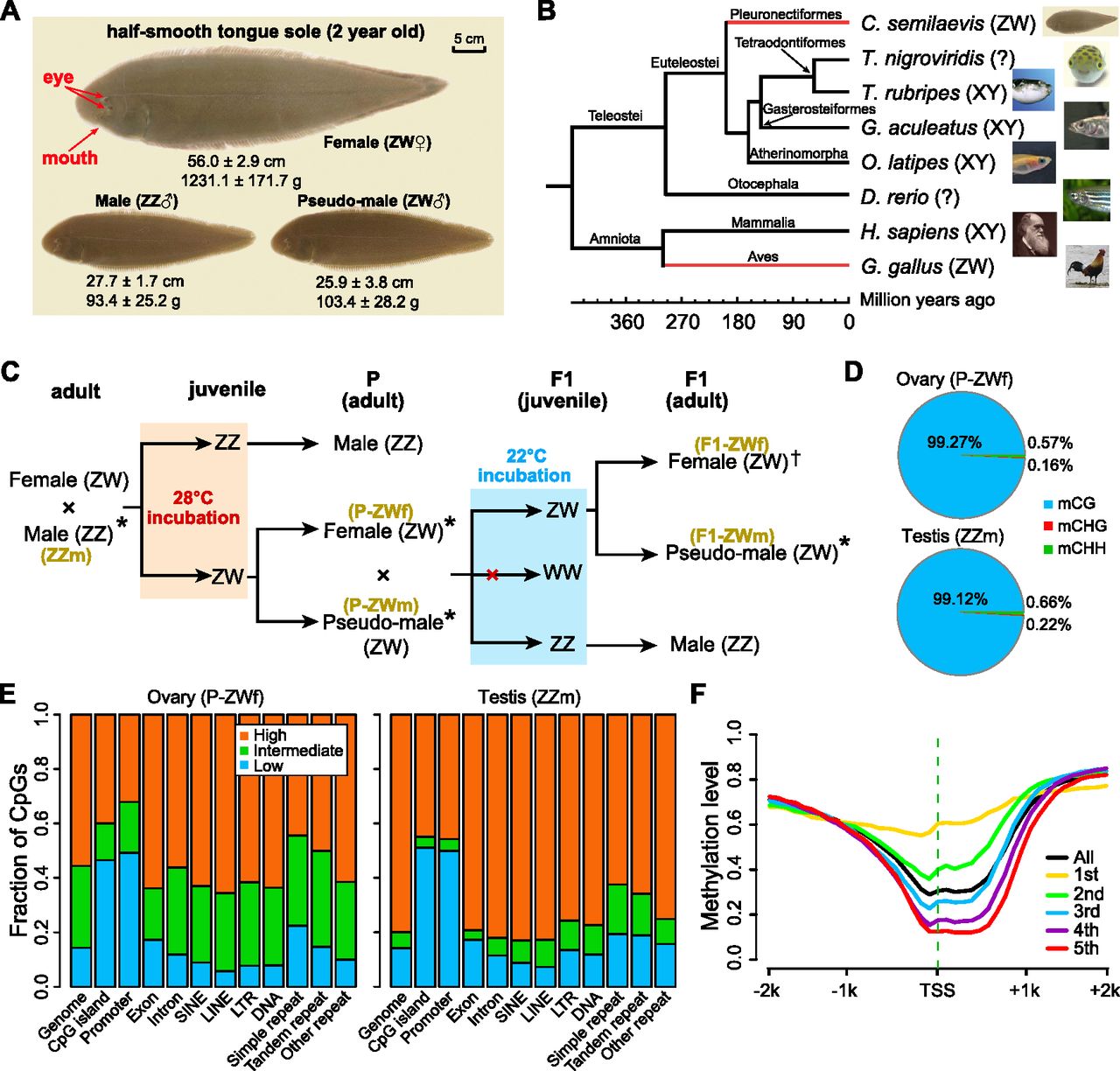
Morphology, phylogeny, and DNA methylation of half-smooth tongue sole. (A) Photos of a female, a normal male, and a pseudomale at 2 yr of age. (B) Genome-based phylogenetic positions and sex chromosome systems of half-smooth tongue sole and other vertebrates. Red lines show that the sex chromosome pairs of tongue sole and chicken were derived from the same ancestral vertebrate proto-chromosome pairs in spite of their distant evolutionary relationship (Chen et al. 2014). (?) No sex chromosomes have been identified so far. (C) Experimental design: The offspring from a normal male (ZZ) and a female (ZW) were exposed to 28°C during the sensitive developmental period, which induced the development of genetic females (ZW) into pseudomales. One of these pseudomales was subsequently crossed with one normal female to produce F1 pseudomales and females. F1 offspring carrying WW sex chromosomes do not exist, as sperms with W instead of Z are not viable. (*) Samples used for both BS-seq and RNA-seq; (†) samples only used for BS-seq. Brown letters in parentheses indicate the symbols for corresponding samples used throughout this paper. (D) Percentage of mCs in the CG, CHG, and CHH contexts. (E) Fraction of CpG in low (methylation level less than 0.25), intermediate (between 0.25 and 0.75), and high (greater than 0.75) methylation levels in different genomic elements. (F) Methylation profile along transcript start sites (TSS) of genes in different expression quintiles. The first quintile is the lowest and the fifth is the highest. Dashed green line indicates the location of TSS. B and C are modified from Figures S16 and 3a in Chen et al. (2014), respectively.



