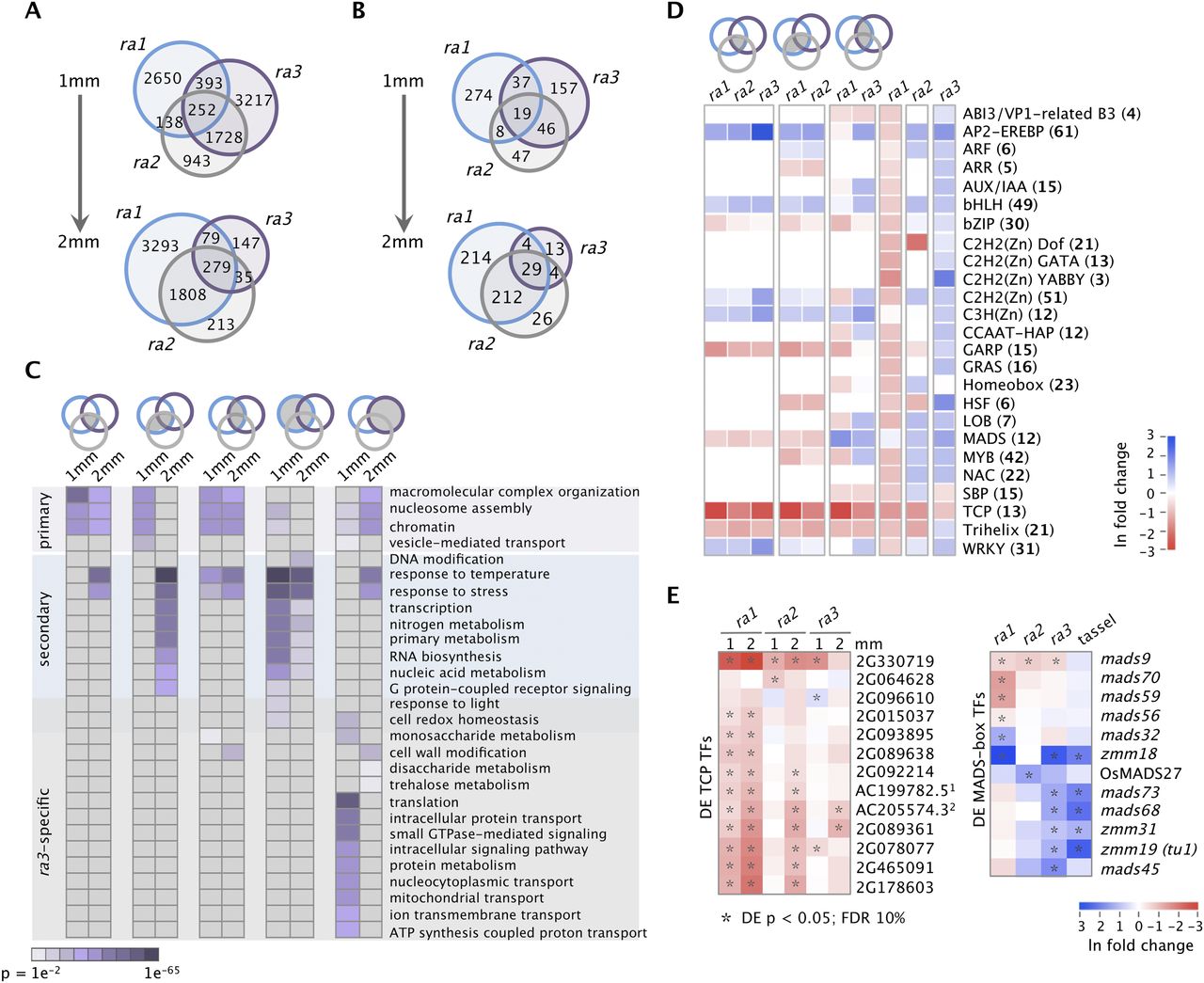
Genetic perturbation of the RAMOSA pathway. (A) Differentially expressed (DE) genes and (B) TFs shared among ramosa (ra) mutant ears at 1- and 2-mm stages (corrected P < 0.05). (C) GO enrichment of biological processes for DE genes shared between different mutants at 1 and 2 mm. Venn diagrams above each set of columns are shaded to represent DE genes shared among mutants (from left to right): DE in ra1, ra2, and ra3; DE in ra1 and ra2 only; DE in ra1 and ra3 only; DE in ra1; DE in ra3. (D) Expression changes for DE TF genes in 1-mm ra mutants relative to wild-type siblings. TFs were grouped by family and the number of DE family members is indicated. Each column represents average expression differences across the TF family in a single mutant (ra1, ra2, or ra3); for TFs DE in more than one mutant, individual mutant profiles are shown, but grouped according to shaded area of Venn diagrams above. From left to right, TF expression profiles are shown if DE in ra1, ra2, and ra3; ra1 and ra2 only; ra1 and ra3 only; ra1; ra2; ra3. (Blue-to-red) Up- to down-regulation. (E) Expression profiles for individual members of two TF families: 13 TCP genes were significantly down-regulated in one or more ra mutants at 1 mm and expression changes across 1- to 2-mm stages are shown for all mutants; 12 MADS-box TF family members showed dynamic expression differences in 1-mm ra1, ra2, ra3 mutants, and 1- to 2-mm wild-type tassel primordia. TCP family members are represented by maize Gramene gene ID: GRMZMx(8); 1AC199782.5_FG003; 2AC205574.3_FG006; MADS maize gene names or closest ortholog in rice are shown.