


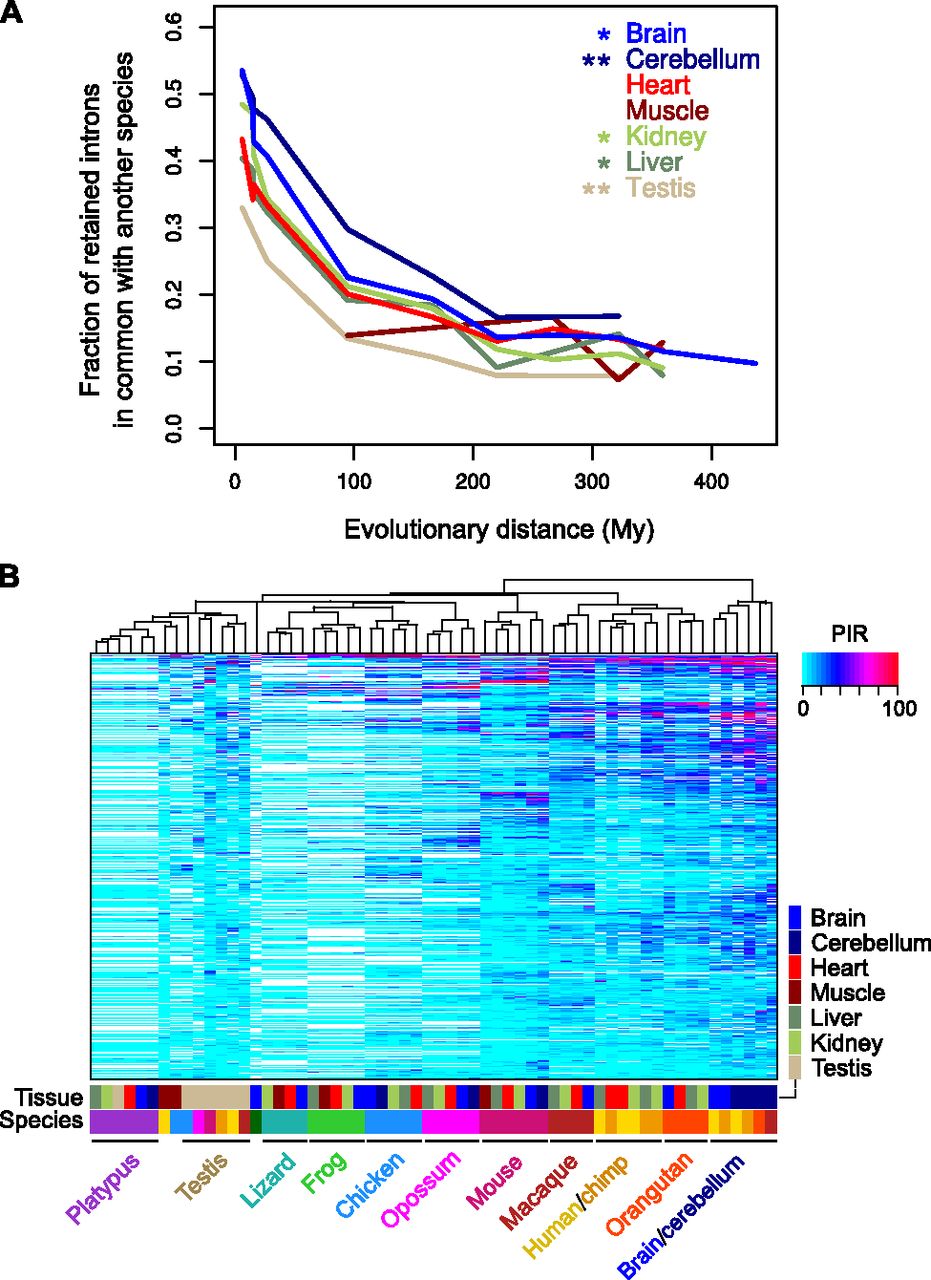
Tissue-specific evolutionary conservation of IR across vertebrates. (A) Proportion of total orthologous introns retained (PIR ≥ 10) in an organ of one species that are also retained in the same organ of another of 11 vertebrate species being compared (see main text and panel B). Lines connect average values for each evolutionary distance. Asterisks indicate significance of differences between each organ and the average of all other organs (*) P < 0.05; (**) P < 0.001 (see Methods for details). (B) Hierarchical clustering of the same vertebrate species’ tissue samples in A, based on comparison of PIR values. Only introns with an intra-species PIR range ≥ 10 in at least three species are compared (n = 4835). (White) Missing data for nonconserved introns.



