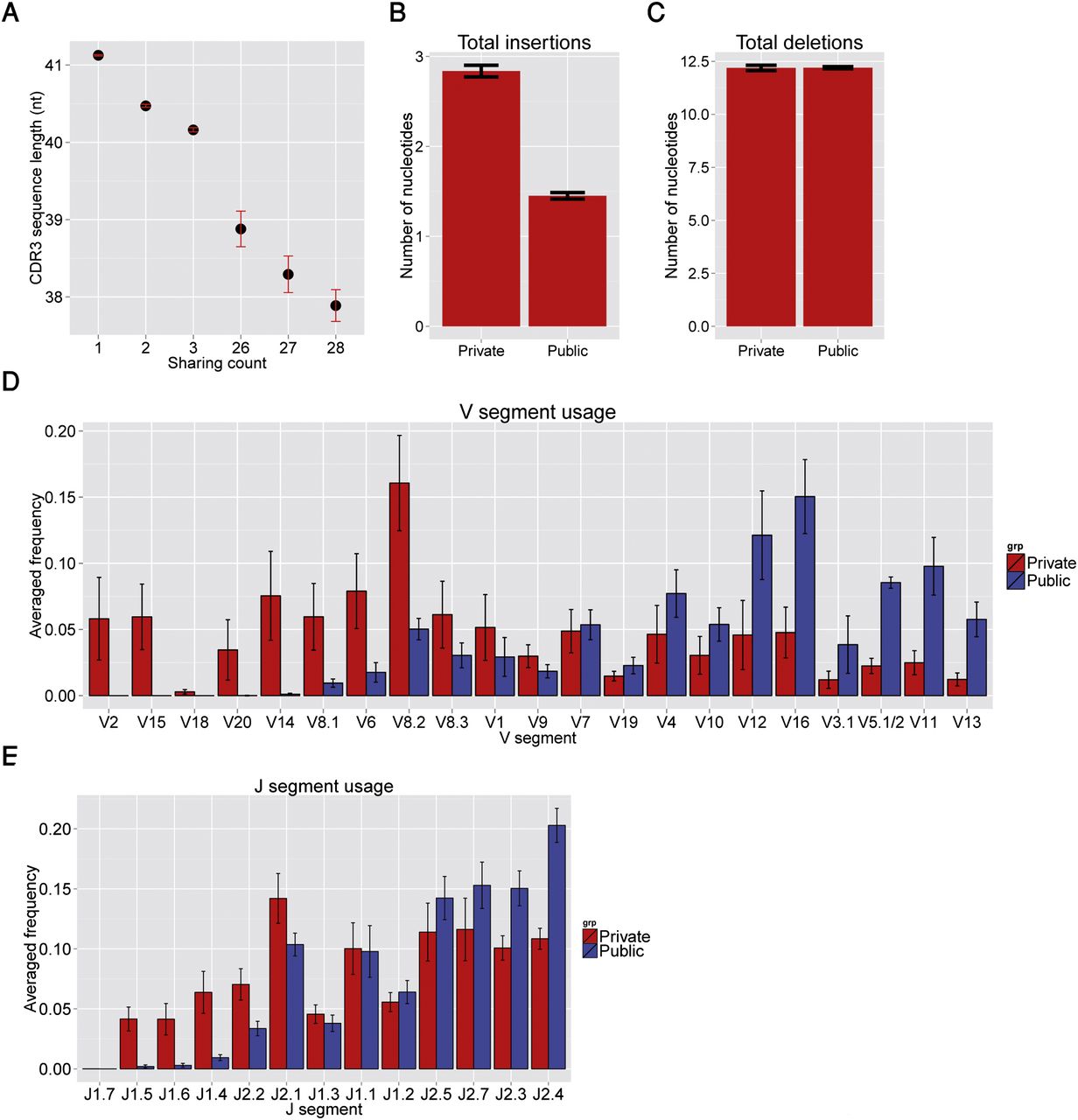
Public CDR3 sequences differ from private sequences in a number of characteristics. (A) The average length (nt) of private (shared by one to three mice) and public (shared by 26–28 mice) CDR3 sequences. Error bars, SE (P < 8.5 × 10⁻⁸, comparing the mean length of CDR3 nt sequences shared by n = 3 and by n = 26 mice). (B,C) The mean number of nt insertions (B, P < 2.2 × 10⁻¹⁶) and nt deletions (C, no significant difference between groups) summed over the V-D and D-J junctions, in private and public sequences. Error bars, SE. (D) Frequencies of V segments in private (red) and public (blue) sequences. (E) Frequencies of J segments in private (red) and public (blue) sequences. Segments in D and E are ordered by the ratio of their frequencies in private vs. public sequences. Error bars, SD. (All V segments except V7 and all J segments except J1.1 and J1.7 showed significant difference P < 0.05).