


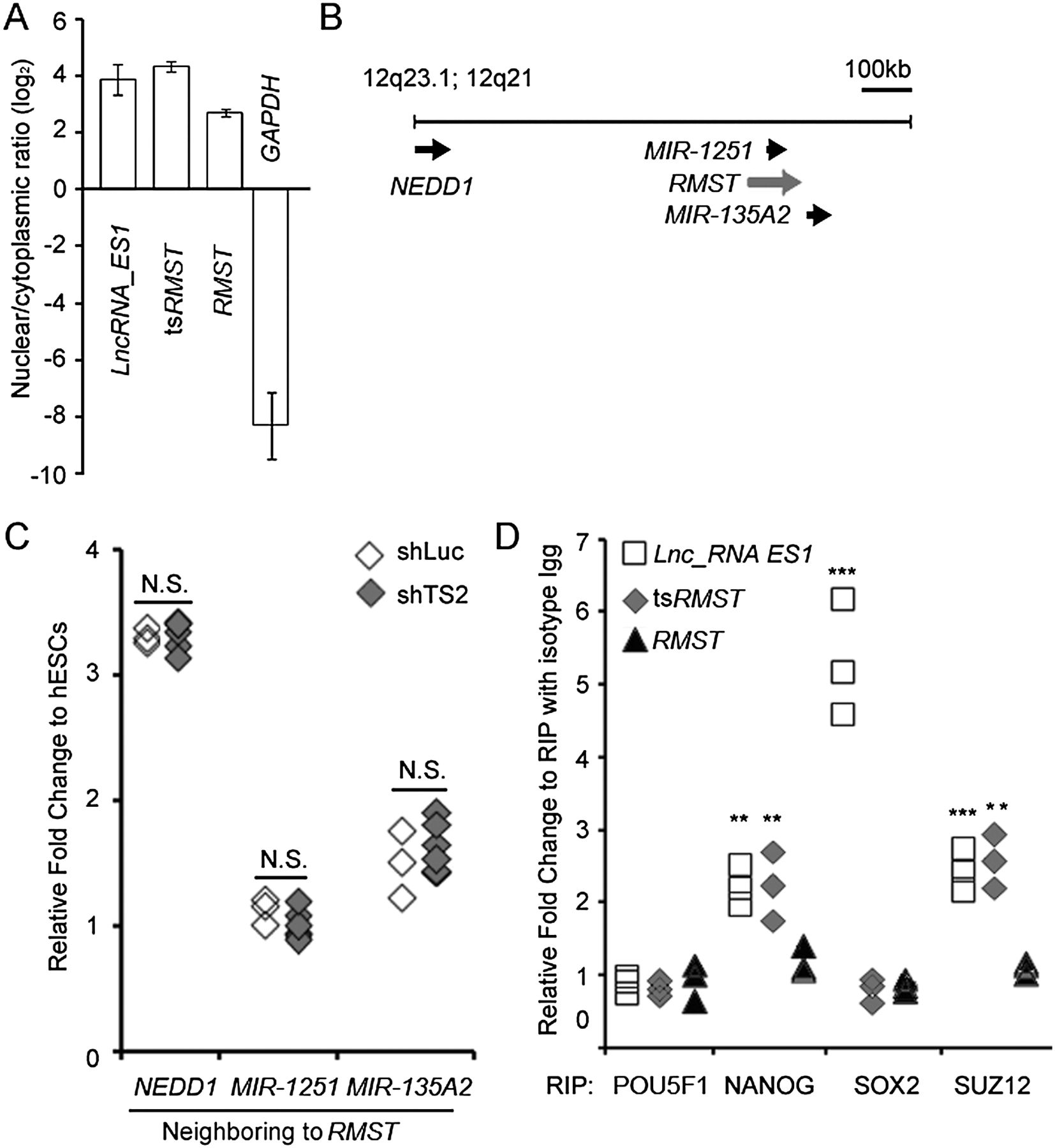
Investigation of the mechanism by which tsRMST regulates pluripotency maintenance and early lineage differentiation. (A) The nuclear to cytoplasmic expression ratio of RMST, tsRMST, lncRNA-ES1, and GAPDH in hESCs. Error bars represent the mean values ± one standard deviation. (B) Neighboring genes (NEDD1) and miRNAs (MIR1251 and MIR135A2) of tsRMST within a 1-MB window on chromosome 12q based on the UCSC annotation. Arrowheads indicate the transcriptional orientations of genes or miRNAs. (C) qRT-PCR analysis of NEDD1, MIR1251, and MIR135A2 on hESCs transfected with control shLuc and shTS2 lentivirus. (D) RIP assays of tsRMST, RMST, and lncRNA-ES1 using antibodies against POU5F1, SOX2, NANOG, and the PRC2 component factor SUZ12 in hESCs. The RIP enrichments of tsRMST, RMST, and lncRNA-ES1 were measured by qRT-PCR, and each value was normalized to the level of background RIP detected for an isotype IgG. P-values were estimated by the two-tailed two-sample t-test. Significance: (*) P < 0.05; (**) P < 0.01; and (***) P < 0.001. (N.S.) Not significant.


