


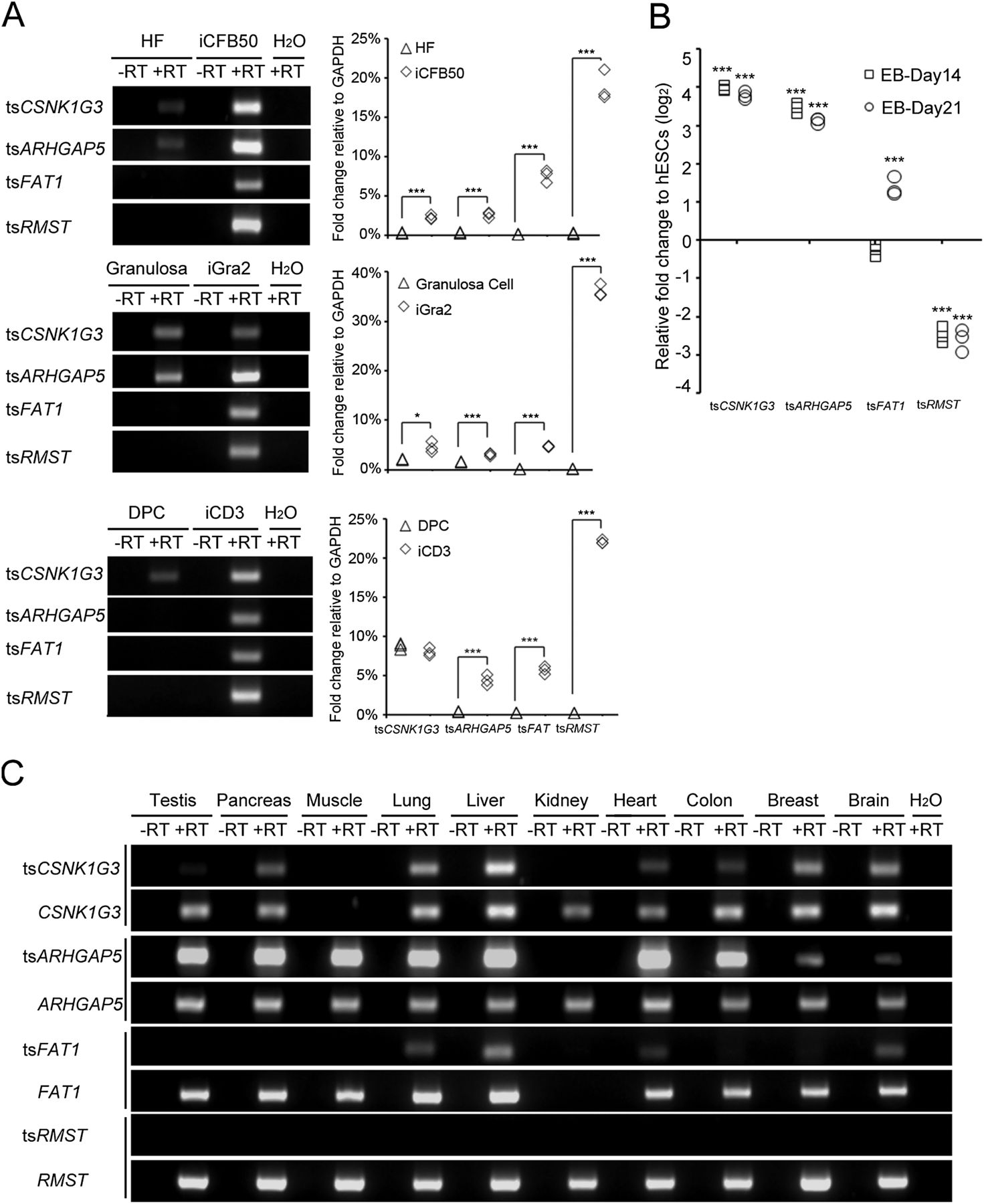
Expression profiles of tsCSNK1G3, tsARHGAP5, tsFAT1, and tsRMST in human pluripotent stem cells and normal tissues. (A) RT-PCR and qRT-PCR analysis of tsCSNK1G3, tsARHGAP5, tsFAT1, and tsRMST in iPSCs derived from human foreskin fibroblasts (iCFB50) (Huang et al. 2010), granulosa cells (iGRA2), and dermal papilla cells (iCD3) with their respective parental cell lines. (HF) Human foreskin fibroblasts; (Gra) granulosa cells; (DPC) dermal papilla cells. (B) qRT-PCR analysis of tsCSNK1G3, tsARHGAP5, tsFAT1, and tsRMST at various stages of hESC in vitro differentiation (i.e., day 14 and day 21). (C) RT-PCR products of the four trans-spliced transcripts (tsCSNK1G3, tsARHGAP5, tsFAT1, and tsRMST) and their corresponding colinear isoforms in ten human normal tissues. All P-values were estimated by the two-sample, two-tailed t-test. Significance: (*) P < 0.05; (**) P < 0.01; and (***) P < 0.001.


