


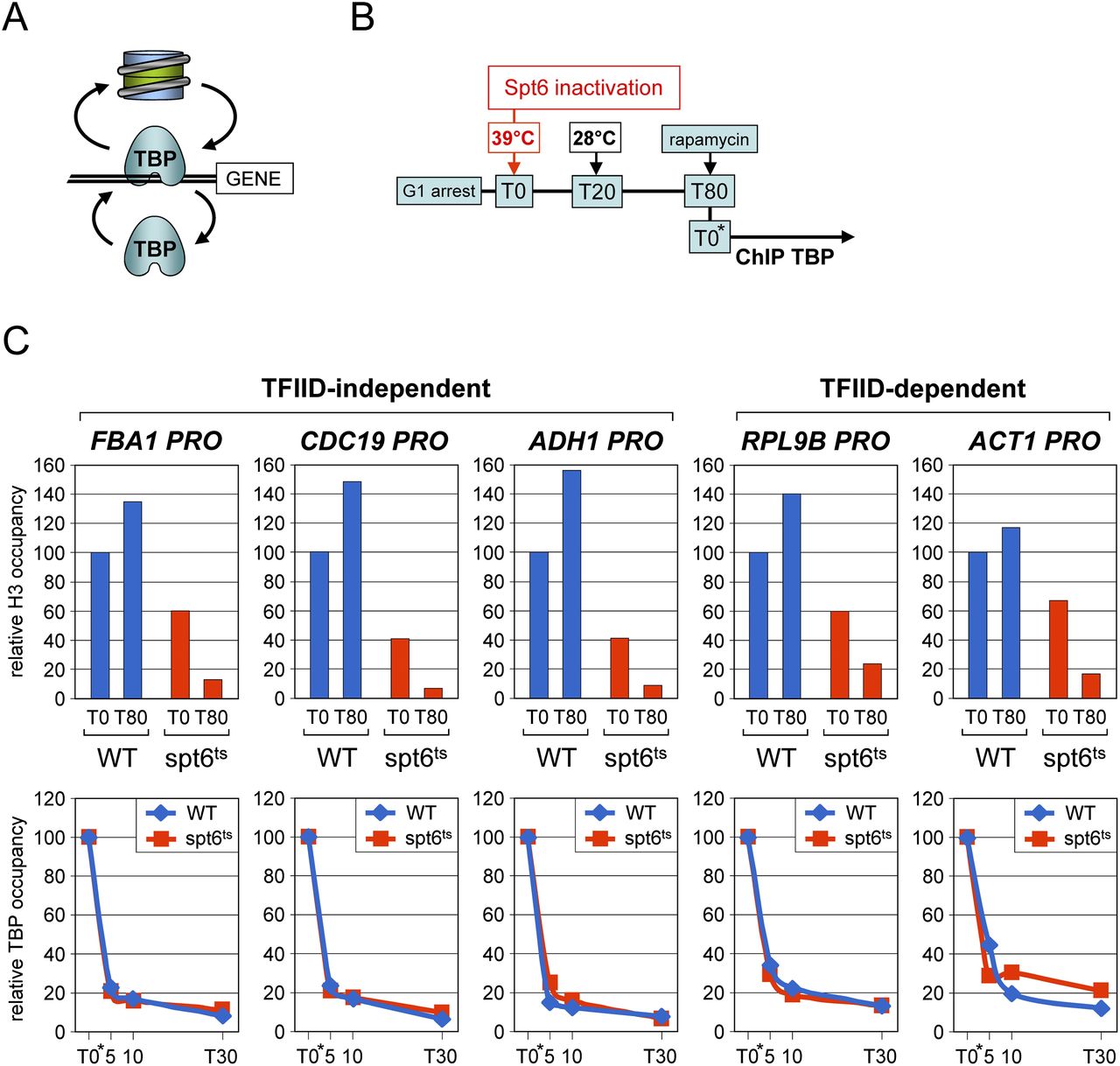
TBP turnover at active promoters in the absence of nucleosomes. See also Supplemental Figure S6. (A) Schematic diagram illustrating the possibility that TBP and nucleosomes compete dynamically for promoter binding. (B) Cells from TBP-anchor-away strains carrying either wild-type or a temperature-sensitive spt6 allele (spt6-14) (Bortvin and Winston 1996) were arrested in G1, and rapidly shifted to 39°C for 20 min in order to inactivate Spt6. At T20, cells were brought back to the permissive temperature. After a 60-min recovery period (T80), rapamycin was added to the culture to deplete TBP from the nucleus. (C) (Upper panel) Nucleosome occupancy just before (T0) and at 80-min (T80) after transient heat inactivation of Spt6 was measured at the indicated TFIID-independent and TFIID-dependent promoters by quantitative ChIP using antibodies against core histone H3. The ChIP signals for each gene are expressed relative to those measured at T0 (=100) in the wild-type Spt6 strain (WT). (Lower panel) TBP occupancy at the same promoters was determined prior to (T0*) and at the indicated time points after addition of rapamycin, as in Figure 2. Note that T0* corresponds to the T80 time point in the upper panel. This experiment was performed in a strain bearing a wild-type TOR1 allele (see Supplemental Methods).



