


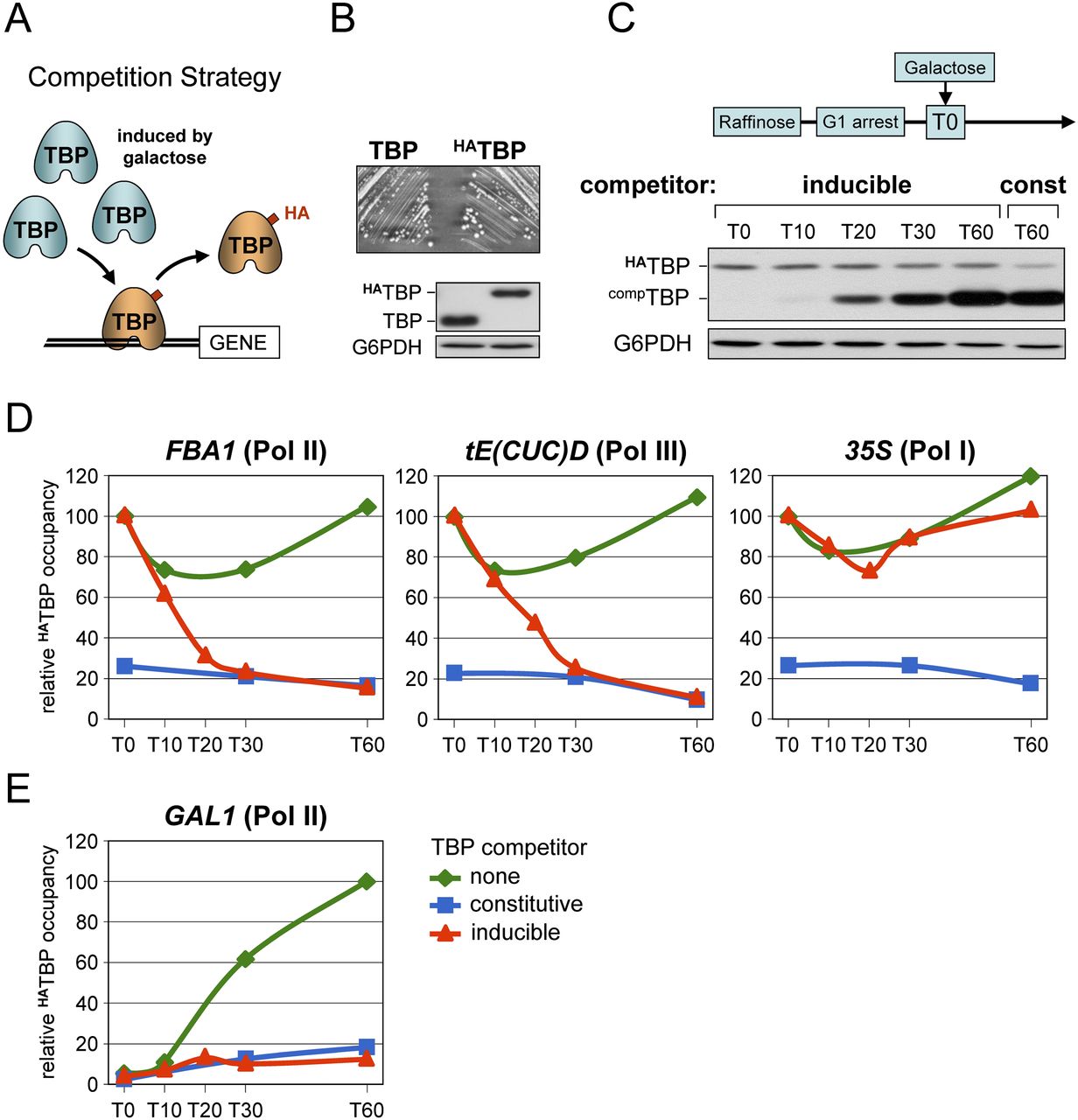
A ChIP-based competition assay reveals high TBP turnover at RNA Pol II and Pol III promoters and stable binding at RNA Pol I promoters. See also Supplemental Figure S1 for additional promoters and Supplemental Figure S9 for biological replicates. (A) Schematic diagram of the competition approach. See text for details. (B) The starting yeast strain expressing an HA-tagged TBP (HATBP) from its native locus and its isogenic wild-type counterpart (TBP) were examined for growth on YPD plates. TBP protein levels were monitored by Western blot analysis using anti-TBP antibodies and anti-G6PDH antibodies as a loading control. (C) Cells expressing HATBP and a plasmid-encoded native TBP competitor (compTBP) from the galactose-inducible GAL1 promoter were grown overnight in raffinose and arrested in G1 by treatment with alpha factor. Expression of native TBP was then induced by directly adding galactose to the medium. Culture aliquots were removed just prior to (T0) and at the indicated time points (in minutes) after galactose addition, and directly processed for Western blot and ChIP analyses (D,E). HATBP and TBP protein levels in whole cell extracts prepared before cross-linking were evaluated using anti-TBP antibodies. G6PDH served as a loading control. The last sample on the right is from cells constitutively expressing TBP (const) from the DED1 promoter. Note that HATBP expression remains constant throughout the experiment. (D) The levels of HATBP occupancy at the indicated promoters and time points (in minutes) were measured by quantitative ChIP analysis using anti-HA antibodies. The strains were treated in parallel as in C and express the TBP competitor from the galactose-inducible GAL1 promoter (inducible), the constitutively active DED1 promoter (constitutive), or no TBP competitor (none). The ChIP signals are relative to those measured at T0 in each strain. These were set to a value of 100, except for the constitutively expressing TBP strain for which the T0 value is relative to the signal detected in the strain expressing no TBP competitor. (E) Same as in D but showing HATBP occupancy at the galactose-induced GAL1 promoter. The ChIP signals are expressed relative to those measured at T60 (=100) in the strain with no TBP competitor (none). Note that the slight increase in HATBP occupancy at T20 following galactose induction of TBP was not observed in an independent experiment (Supplemental Fig. S9).



