


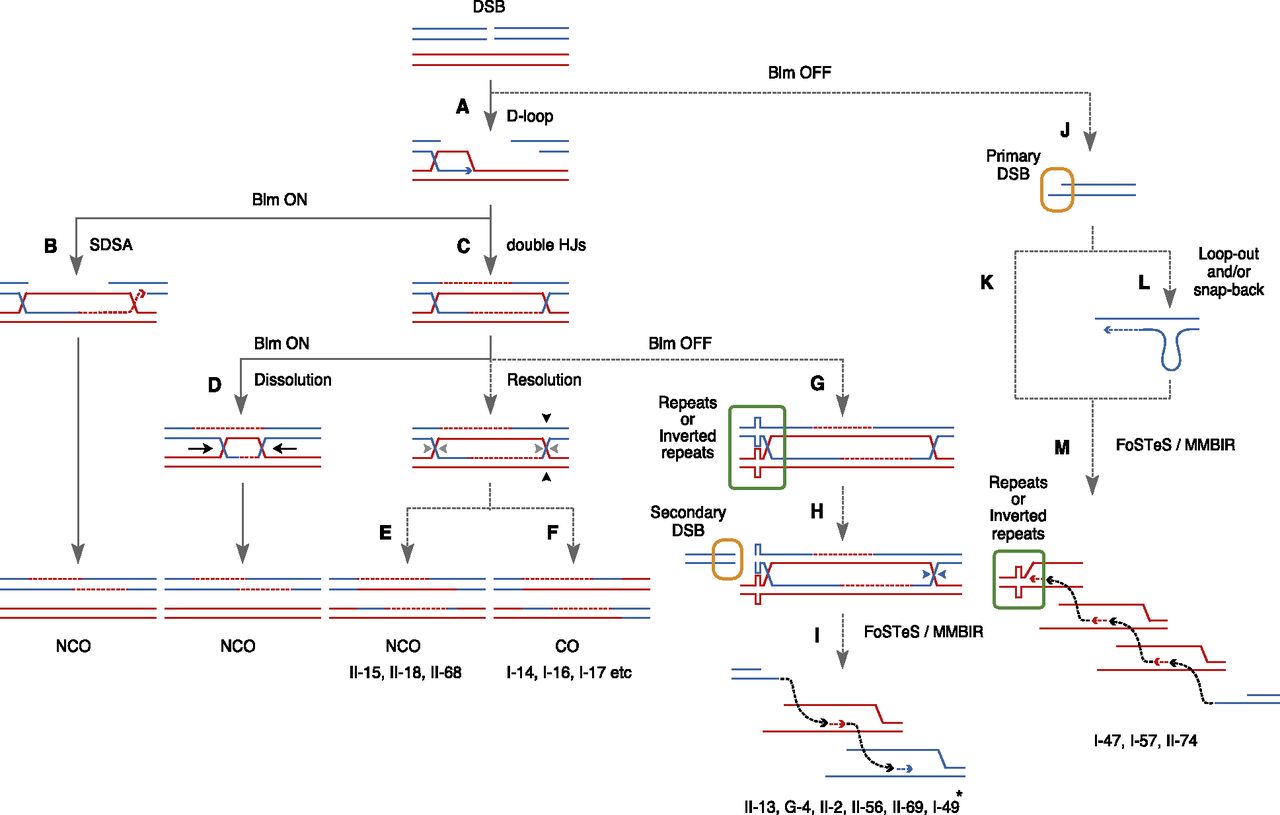
Proposed molecular mechanisms for genomic rearrangements observed in the present study. Blue and red bars represent the B6-derived and 129-derived chromosomes, respectively. (Top) A site-directed DSB is induced at the knocked-in I-SceI site near the Aprt locus on the B6-derived chromosome 8, leading to the activation of cellular DSB repair pathways. The following steps (A–M) are described in detail in the text. Solid arrows represent pathways that are dominant in the Blm-proficient (Blm ON) conditions, while dotted arrows represent pathways that become predominant in the Blm-deficient (Blm OFF) conditions. Corresponding clone names are indicated at the bottom. (*) Clone devoid of apparent breakpoint microhomology.



