


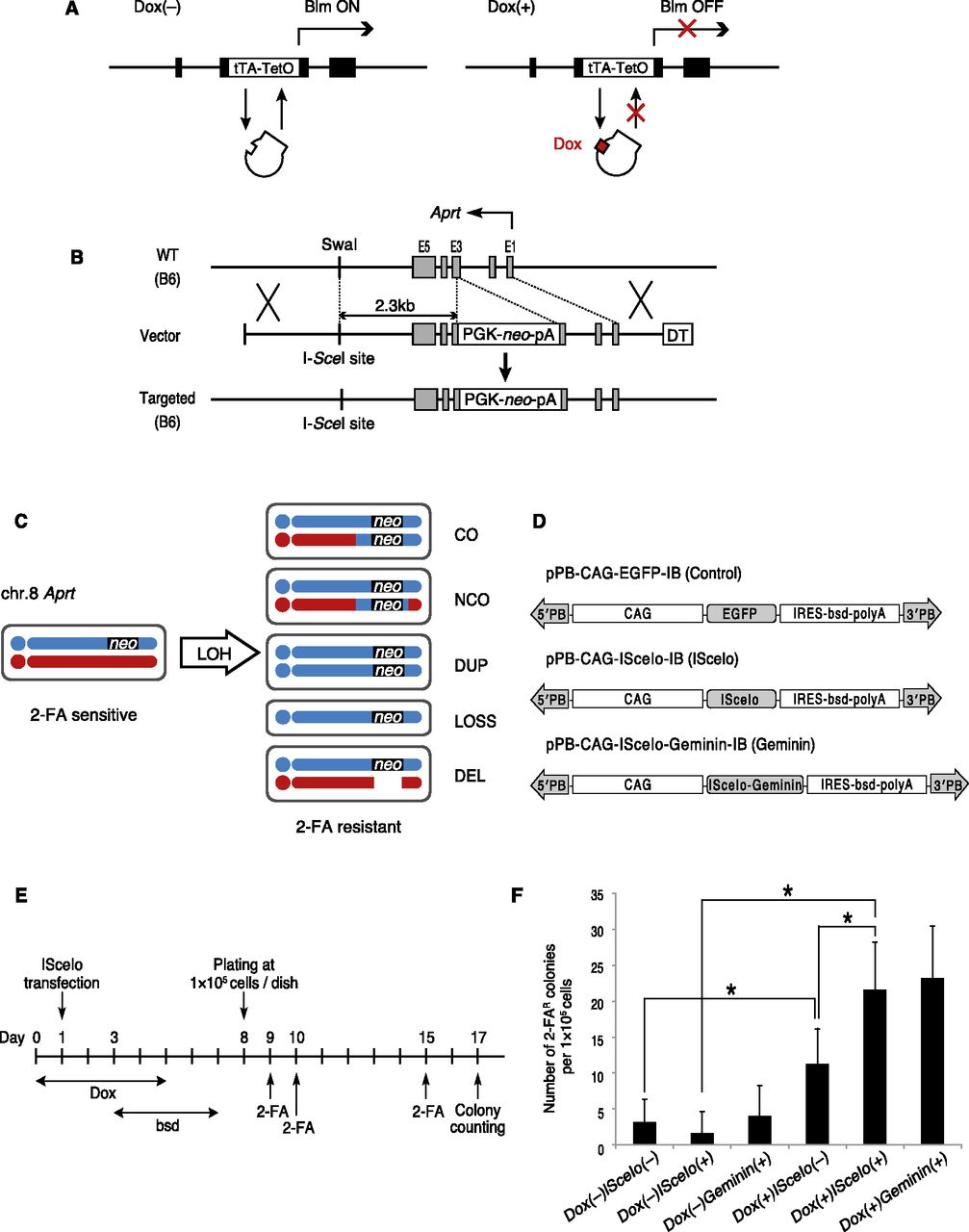
Experimental design and synergistic enhancement in the rate of LOH by the combination of transient loss of Blm and DSB induction. (A) Schematic representation of the Dox-inducible knockdown construct for the Blmtet/tet ES cell line (Horie et al. 2011). A Tet-off cassette, consisting of tetracycline-regulated transactivator (tTA) and a basal promoter containing Tet operator sequences (TetO), was inserted into both alleles of the Blm gene in mouse F1 (B6 × 129) ES cells. (Left) In the absence of Dox, the tTA protein binds to the tetO sequence and activates Blm gene expression. (Right) The application of Dox prevents the binding of tTA to tetO and represses Blm expression in a reversible manner. (B) Targeting strategy. A wild-type neomycin resistance (neo) gene cassette was inserted into exon 3 of the Aprt gene on the B6-derived chromosome 8 of Blmtet/tet ES cells, accompanied by the introduction of an I-SceI recognition sequence into the SwaI site 2.3 kb centromeric to exon 3, resulting in Blmtet/tetAprtneo/+ ES cells. (DT) Diphtheria toxin A fragment, (WT) wild type. (C) A negative selection scheme for LOH using 2-fluoroadenine (2-FA). In theory, five LOH patterns—crossover (CO), noncrossover (NCO), chromosomal duplication (DUP), chromosomal loss (LOSS), and partial chromosomal deletion (DEL)—could be recovered. (D) Expression vectors used in this study. 5′PB and 3′PB are terminal repeats of the piggyBac transposon. (EGFP) Enhanced green fluorescent protein, (ISceIo) codon-optimized I-SceI, (ISceIo-Geminin) a fusion gene of ISceIo and geminin, (CAG) CAG promoter, (IRES) internal ribosomal entry site, (bsd) blasticidin resistance gene, (polyA) polyadenylation signal. (E) Schematic representation of the cell culture protocol. See text for details. (F) Total number of 2-FA-resistant colonies generated from 1 × 10⁵ Blmtet/tetAprtneo/+ ES cells subjected to different treatments as indicated: Dox(+) or Dox(–), 5-d culture in the presence or absence of Dox to switch Blm expression “off” or “on”, respectively; ISceIo(+) or ISceIo(–), transfection of the ISceIo vector for DSB induction or the control vector, respectively; Geminin(+), transfection of the Geminin vector. The error bars represent the standard deviation of four to seven independent experiments. (*) P < 0.05, Student's t-test.



