


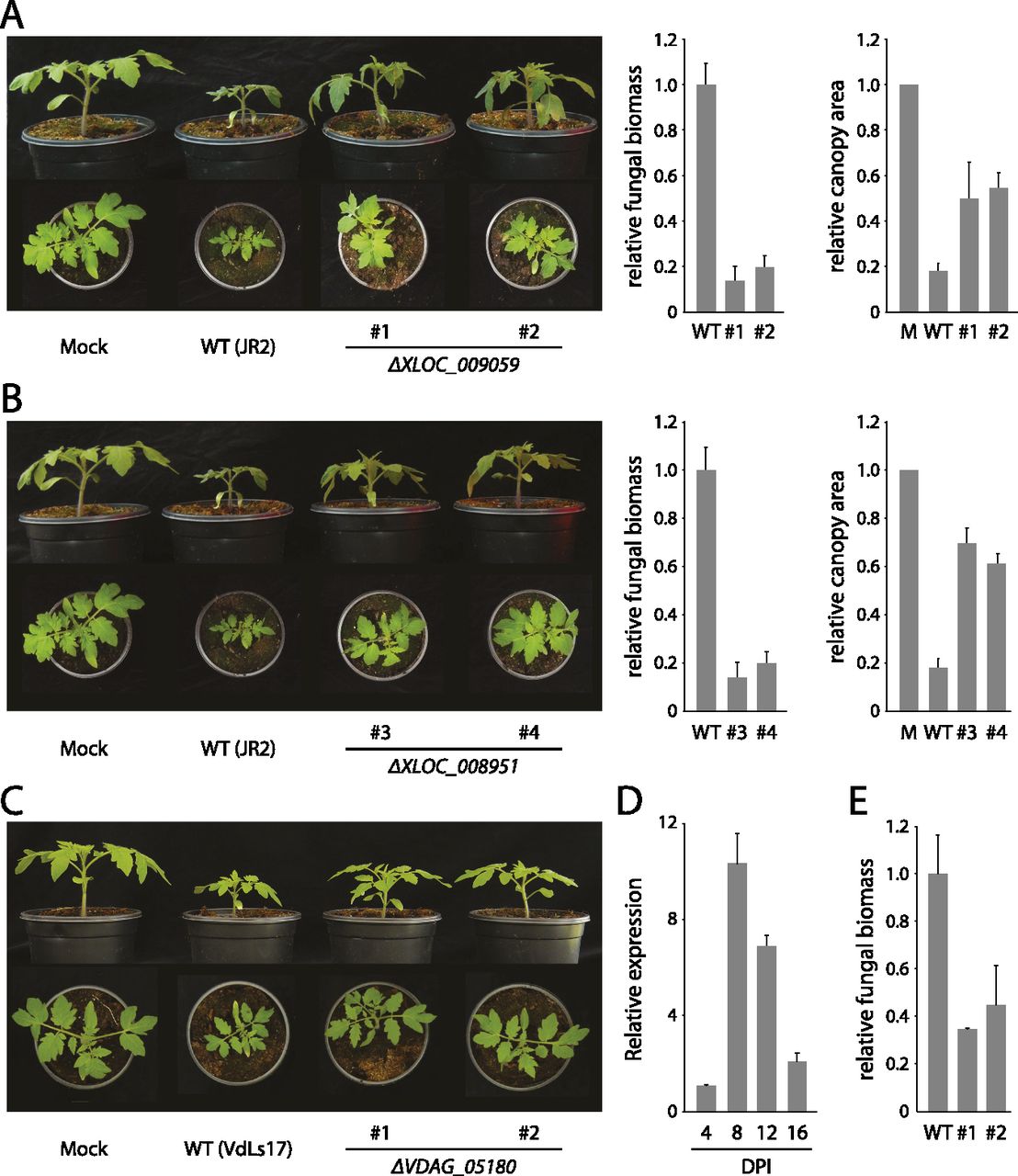
Lineage-specific genomic regions of Verticillium dahliae harbor effectors that are required for virulence on tomato. (A) Two independent XLOC_009059 deletion strains (ΔXLOC_009059) show compromised virulence on tomato (cv. MoneyMaker), evidenced by reduced stunting when compared with inoculation with wild-type V. dahliae (WT, JR2), increased canopy area, and reduced V. dahliae biomass accumulation. (B) Two independent XLOC_008951 deletion strains (ΔXLOC_008951) show compromised virulence on tomato (cv. MoneyMaker), evidenced by reduced stunting when compared with inoculation with wild-type V. dahliae (WT, JR2), increased canopy area, and reduced V. dahliae biomass accumulation. (C) Two independent VDAG_05180 deletion strains (ΔVDAG_05180) show compromised virulence on tomato (cv. Motelle), evidenced by reduced stunting when compared with inoculation with wild-type V. dahliae (WT, VdLs17). Photographs are taken at 12 DPI. (D) Expression of VDAG_05180 in V. dahliae strain VdLs17 during infection of Nicotiana benthamiana between 4- and 16-d post-inoculation (DPI). (E) Reduced V. dahliae biomass in plants inoculated with two independent VDAG_05180 deletion strains when compared with wild-type V. dahliae (WT, VdLs17) at 8 DPI. Error bars represent standard error of three replicate experiments.



