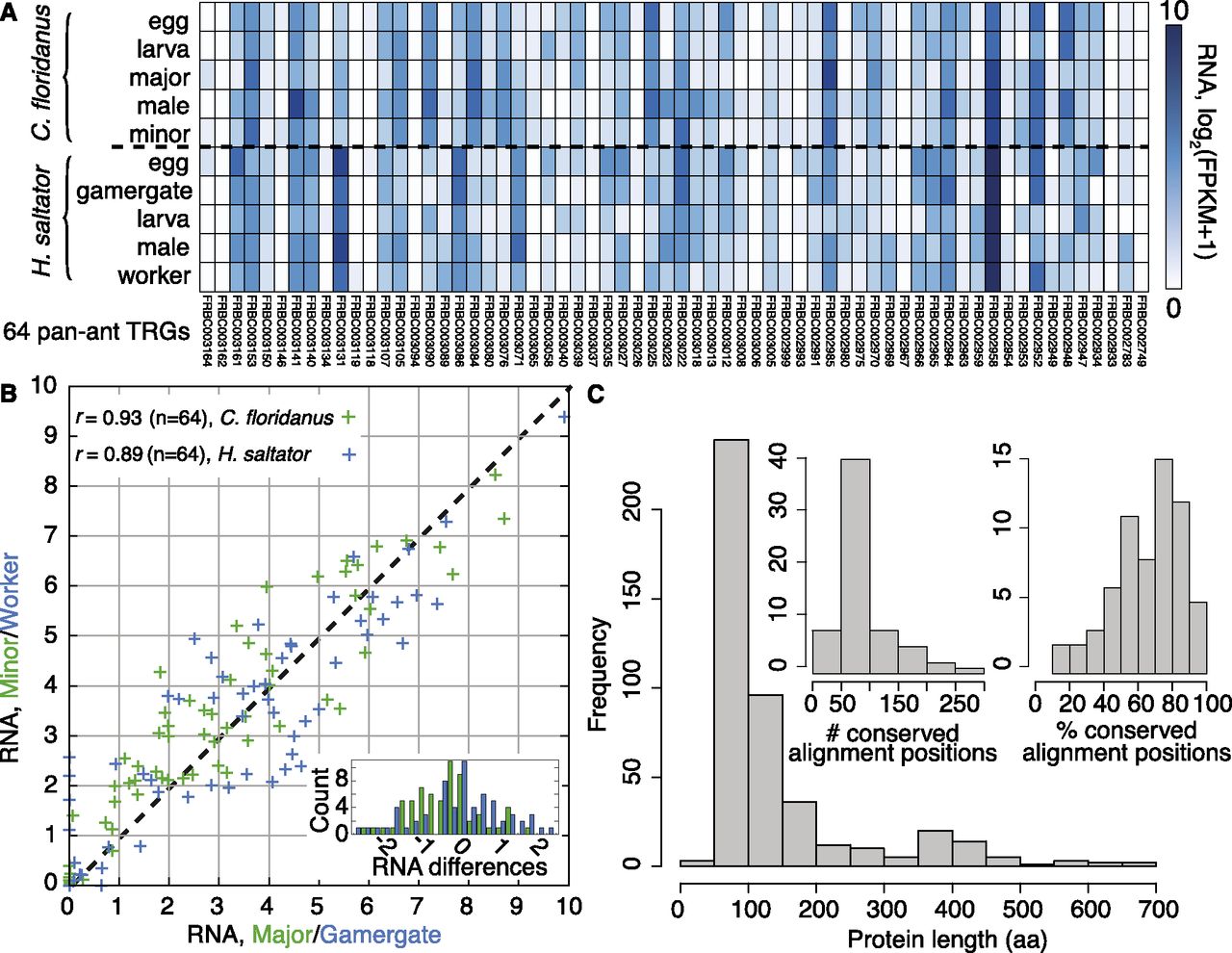
Analysis of 64 pan-ant taxonomically restricted genes (TRGs). (A) RNA expression support for 64 TRGs that are orthologous among all seven ant species but not found in other genomes. RNA expression levels, estimated as log2(FPKM + 1), are shown for various developmental stages and adult castes of C. floridanus and H. saltator. (B) Expression correlation between adult worker castes in C. floridanus (major vs. minor; green) and H. saltator (gamergate vs. worker; blue) for the 64 novel ant TRGs; Pearson's correlation coefficients are shown. (Inset) Histogram of differences in gene expression levels between castes (major − minor in green, gamergate − worker in blue) per gene. (C) Length distribution (in amino acids) of the 64 novel ant TRGs. (Inset) Distribution of the number (left) and percentage (right) of conserved alignment positions (see Supplemental Text 1).