


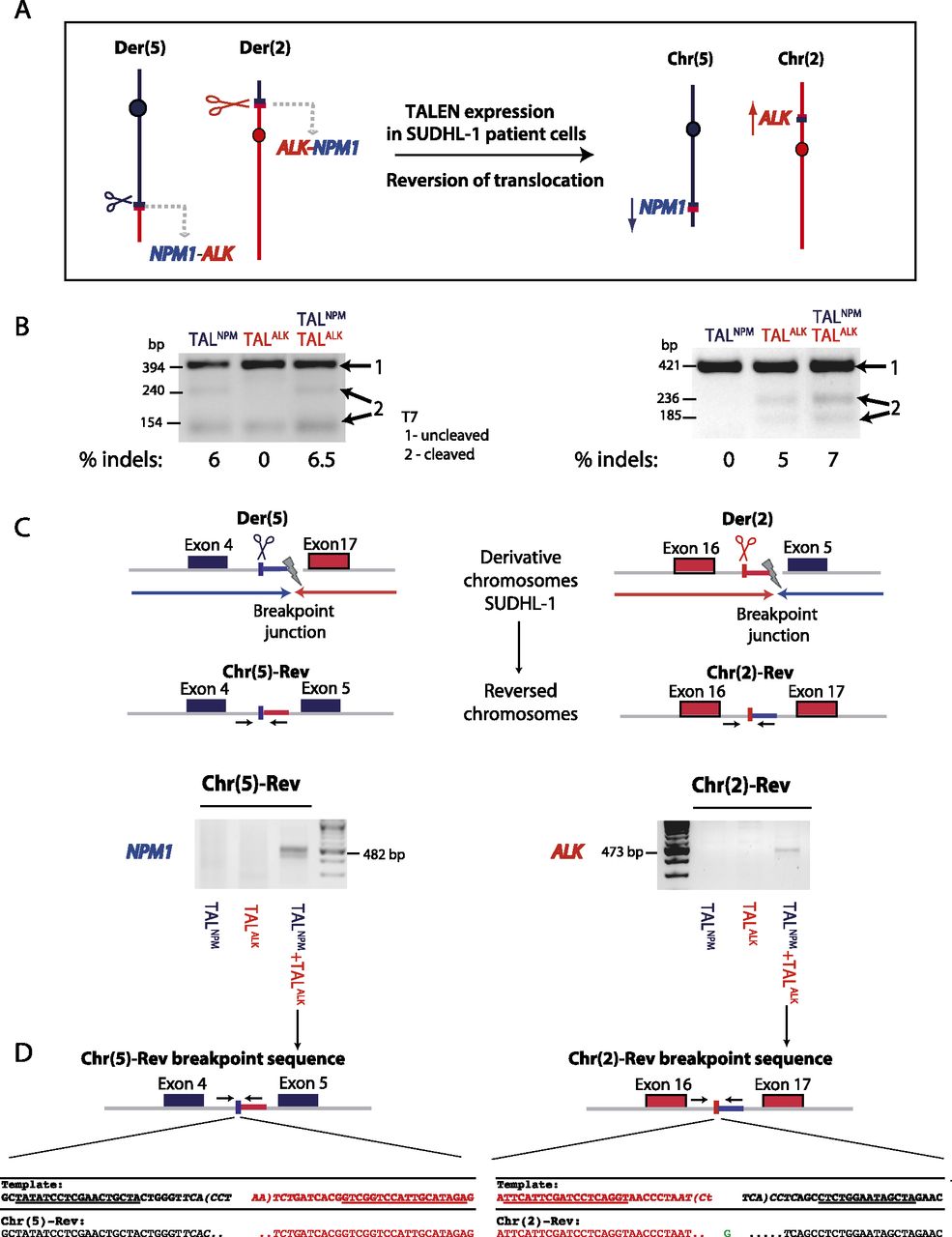
Reversion of the t(2;5)(p23;q35) translocation in SUDHL-1 cells. (A) Patient-derived SUDHL-1 cells carry the t(2;5)(p23;q35) translocation and express the NPM1–ALK fusion gene from der(5). To reverse the translocation, TALNPM and TALALK are expressed to create DSBs in both fusion genes; repair between the derivative chromosomes restores intact chromosomes 5 and 2. (B) TALNPM and TALALK efficiently cleave target loci in SUDHL-1 cells. Cleavage is monitored by the T7-endonuclease assay directed to the NPM1 (left) and ALK (right) loci. (C) PCR detection of revertant chromosomes 2 and 5. Reversion is only detected after expression of both TALNPM and TALALK. Because the TALENs cleave to the side of the translocation breakpoint junctions in the SUDHL-1 cells, segments of the other chromosome remain to “tag” the revertant chromosomes to distinguish them from chromosomes that did not participate in the translocation. (D) Sequences of representative revertant chromosomes 5 and 2, which restore the NPM1 and ALK genes, respectively.



