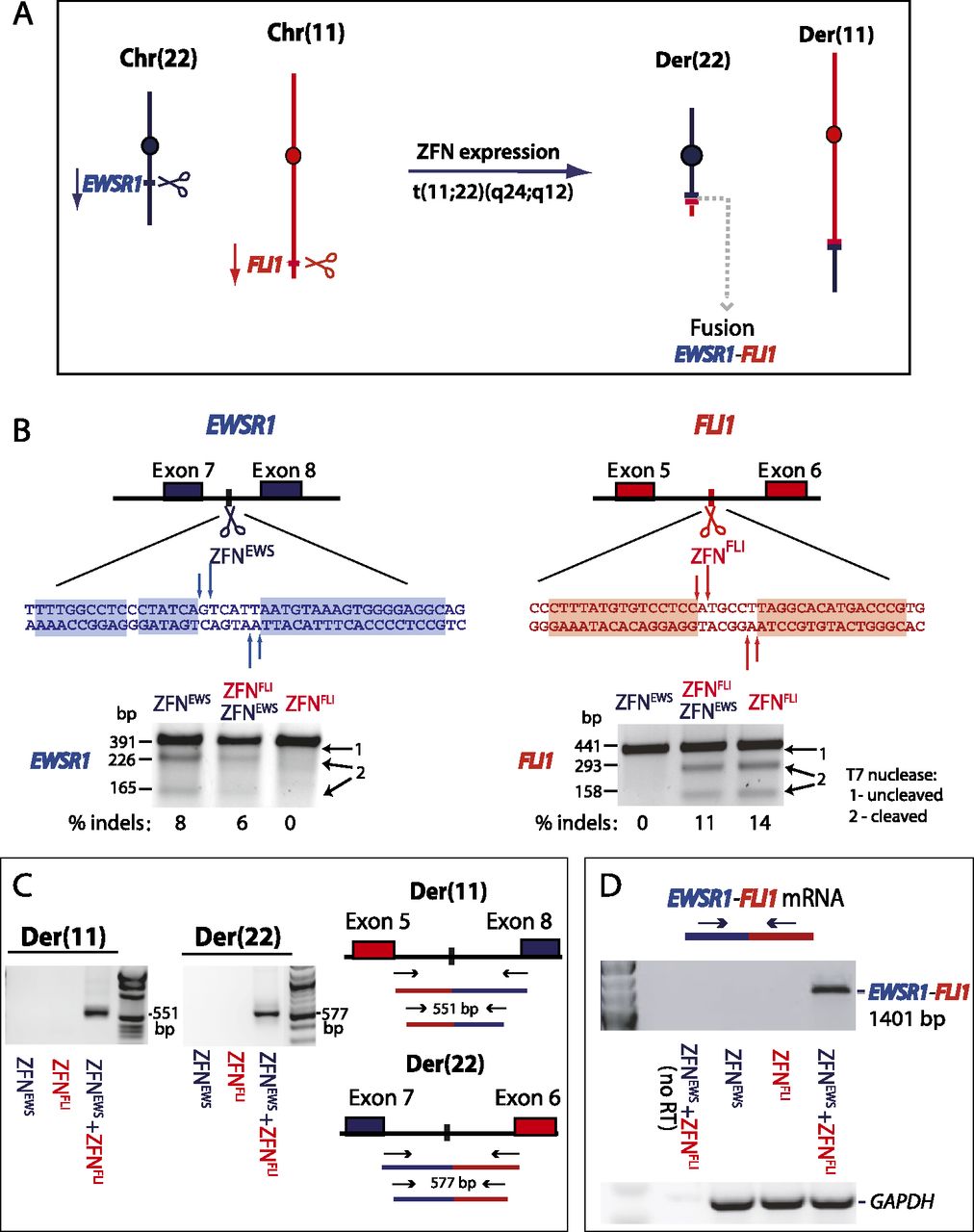
Induction of t(11;22)(q24;q12) translocations in hES-MP cells with ZFNs. (A) Ewing sarcoma translocations involve breakpoints within the EWSR1 and FLI1 genes on chromosomes 22 and 11, respectively, creating an EWSR1–FLI1 fusion gene on der(22). To induce t(11;22)(q24;q12), ZFNs are expressed in hES-MP cells to create DSBs (scissors) in both genes. (B) ZFNEWS and ZFNFLI cleavage sites are within EWSR1 and FLI1 introns, respectively, relevant to the EWSR1–FLI1 translocation. Zinc fingers in the ZFNs are designed to bind to the shaded sequences. (Arrows) The presumed DSB sites after FokI nuclease domain cleavage. ZFN cleavage activity in hES-MP cells is monitored by a T7-endonuclease assay (Guschin et al. 2010). The region around the ZFN site is amplified; the amplified product is then denatured, reannealed, and then subjected to T7 endonuclease cleavage. Insertions and deletions (indels) characteristic of imprecise DSB repair by NHEJ give rise to T7 endonuclease-cleavable DNA. (C) Nested PCR to detect derivative chromosomes der(11) and der(22) in hES-MP cells. Translocation breakpoint junctions are only detected after expression of both ZFNEWS and ZFNFLI. (D) RT-PCR detection of the EWSR1–FLI1 fusion transcript after ZFNEWS and ZFNFLI expression in hES-MP cells. The forward primer overlaps the exon 2/3 junction of EWSR1, and the reverse primer is within exon 9 of FLI1, amplifying most of the EWSR1–FLI1 coding sequence.