


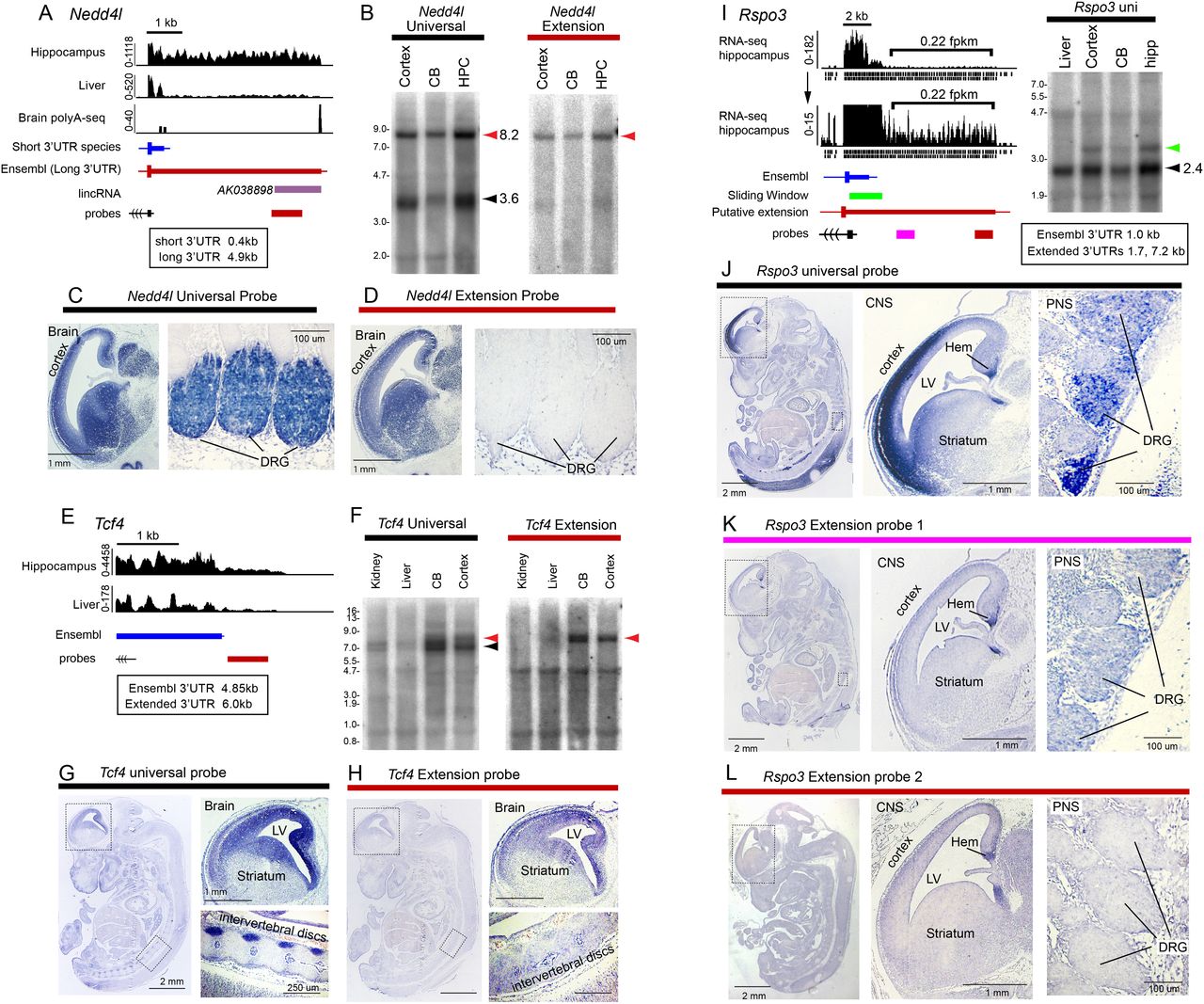
In situ hybridization of mouse embryos reveals localization of extended 3′ UTR isoforms in specific brain regions. (A) RNA-seq data for Nedd4l indicate an alternative 4.9-kb-long 3′ UTR isoform that includes a proposed lincRNA AK038898. (B) Northern blotting demonstrates that an AK038898 probe detects the long 3′ UTR isoform of Nedd4l. (C) A Nedd4l universal probe detects expression in both brain and dorsal root ganglia (DRG). (D) A probe directed against the very distal portion of the Nedd4l 3′ UTR extension detects only brain expression. (E) RNA-seq data for Tcf4 indicate the existence of a 3′ UTR extension of the annotated gene model, with preferential expression in hippocampal data. (F) Tissue Northern blot using a distal probe confirms the existence of a discrete band expressed in brain that corresponds to a 3′ UTR extension isoform. (G) In situ hybridization to a probe in the common 3′ coding exon detects Tcf4 predominantly in the CNS and the intervertebral discs; (LV) lateral ventricle. A whole-embryo cross-section is shown at left, and the regions boxed are enlarged at right. (H) The Tcf4 3′ UTR extension probe only detects expression in the brain. (I) RNA-seq data for Rspo3 indicate a candidate 3′ UTR extension, although this level of expression (0.22 FPKM) was below our cutoff for genome-wide calls of 3′ UTR extensions. (J) A universal Rspo3 probe predominantly detects CNS expression in the cortex and hem, as well as PNS expression in the spinal cord, mainly in dorsal root ganglia (DRG). (K) The intermediate Rspo3 extension probe hybridizes specifically to the cortical hem. (L) A probe directed against the very low abundance Rspo3 extension region similarly detects expression in cortical hem.



