


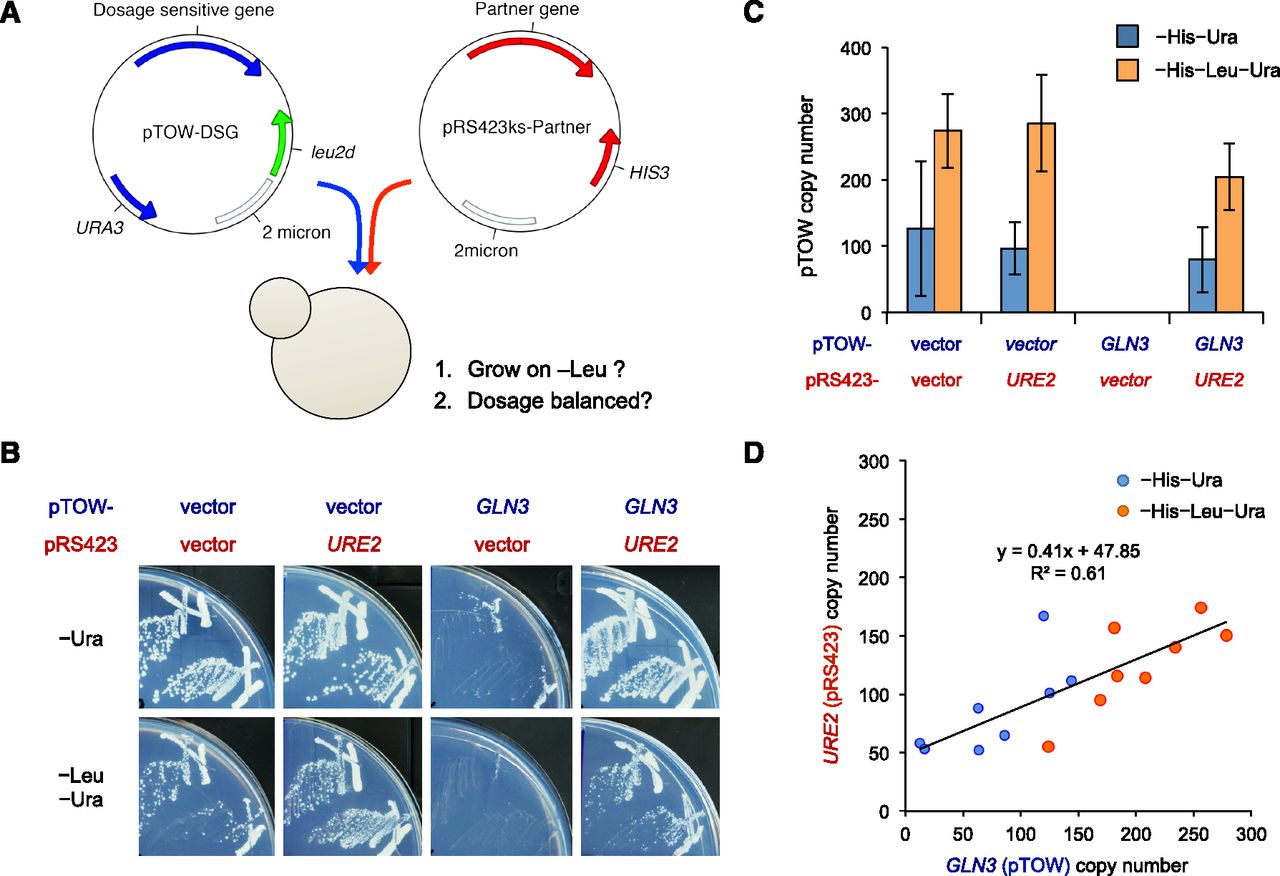
Testing dosage balance between DSGs and their candidate partners. (A) The experimental design of 2D-gTOW to determine whether two genes are dosage partners (Kaizu et al. 2010). First, we transformed a yeast strain with two plasmids expressing DSG and its candidate partner and then tested whether the transformant could grow under the −Leu condition and whether both the plasmids were balanced. (B,C,D) Examples of 2D-gTOW experiments with GLN3 (DSG) and its partner URE2. (B) Plate assay: High copy URE2 supports the growth of yeast cells with high-copy GLN3. (C) Copy numbers of pTOW-GLN3 and pRS423ks-URE2 under the low-copy (−His−Ura) and high-copy (−His−Leu−Ura) conditions. (D) The copy numbers of GLN3 and URE2 in 2D-gTOW experiments are balanced. Other experimental results can be found in Supplemental Figures S11, S12, and S13.



