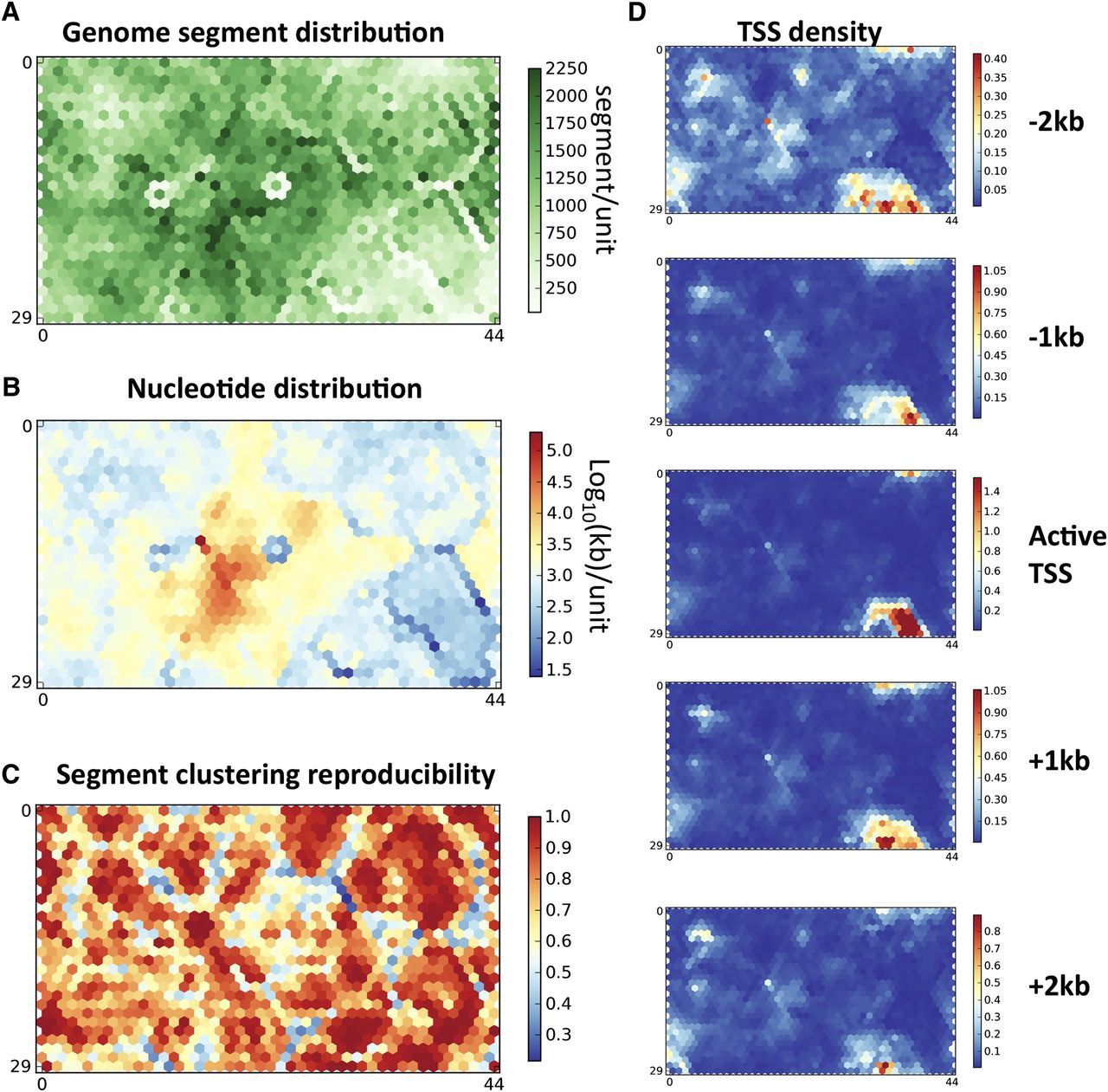
Map organization. (A) The segment count distribution over the map is uneven. While the average number of segments per unit is 1170, individual units range from 30 to 9334 segments. Note the distinct 1-unit-wide boundaries that contain very few segments separating denser regions. (B) The nucleotide distribution reflects the segment count, with the units with the most segments also containing the most nucleotides. These segments are also larger, thus accounting for the large portion of the genome that has little to no signal. (C) Reproducibility of clustering of two segments in the same unit or adjoining units as described in the text. (D) TSS-centric organization of active proximal promoters. The unit densities of points −2 kb, −1 kb, 0 bp, +1 kb, and +2 kb of GENCODE 7 TSS show the distinct organization of active promoters driven primarily by a common set of genes expressed in more than one cell type.