


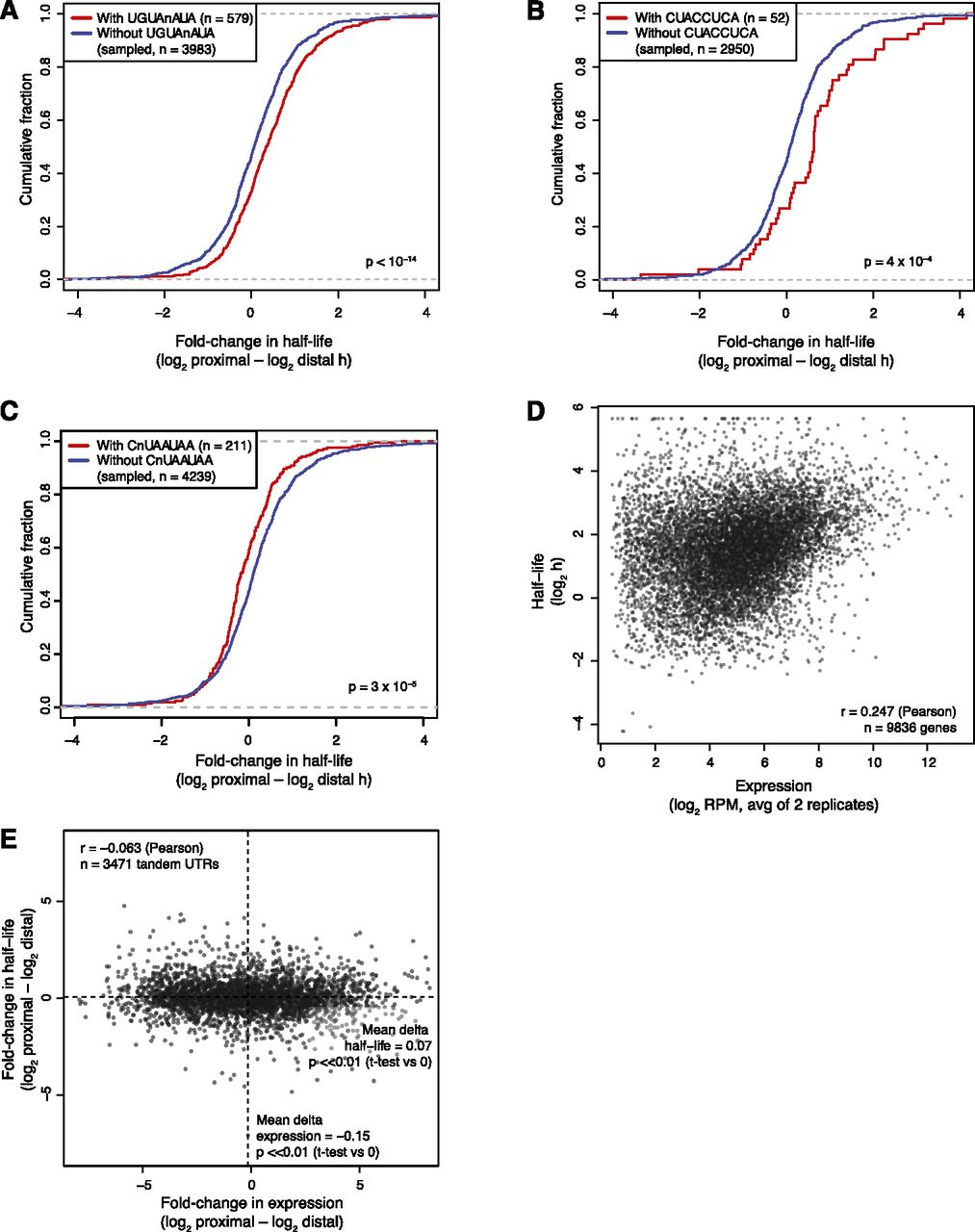
Relationships between isoform half-life and either motifs or isoform accumulation. (A) Half-life differences for proximal versus distal tandem UTR isoforms containing a PUF-binding site in the distal region (red curve) or those for length-matched control tandem UTRs without the site (blue curve). Fold changes >0 indicate a more stable proximal isoform, and those <0 indicate a more stable distal isoform. The P-value reports a statistically significant difference between the two cumulative distributions (Mann-Whitney test). (B) Half-life differences for proximal versus distal tandem UTR isoforms with and without an 8-nt site for the let-7 miRNA in the distal region. Otherwise, as in A. (C) Half-life differences for tandem UTR isoforms with and without the top candidate stabilizing motif in the distal region. Otherwise, as in A. (D) Relationship between half-life and steady-state mRNA accumulation, calculated as the average over all 3′ UTR isoforms. mRNA expression levels were the average of two biological replicates. (E) Differences in proximal and distal tandem UTR half-lives compared to differences in their accumulation. On average, distal isoforms were slightly more highly expressed than were proximal isoforms, as indicated by the vertical line, but proximal isoforms were on average slightly more stable than were distal isoforms, as indicated by the horizontal line.


