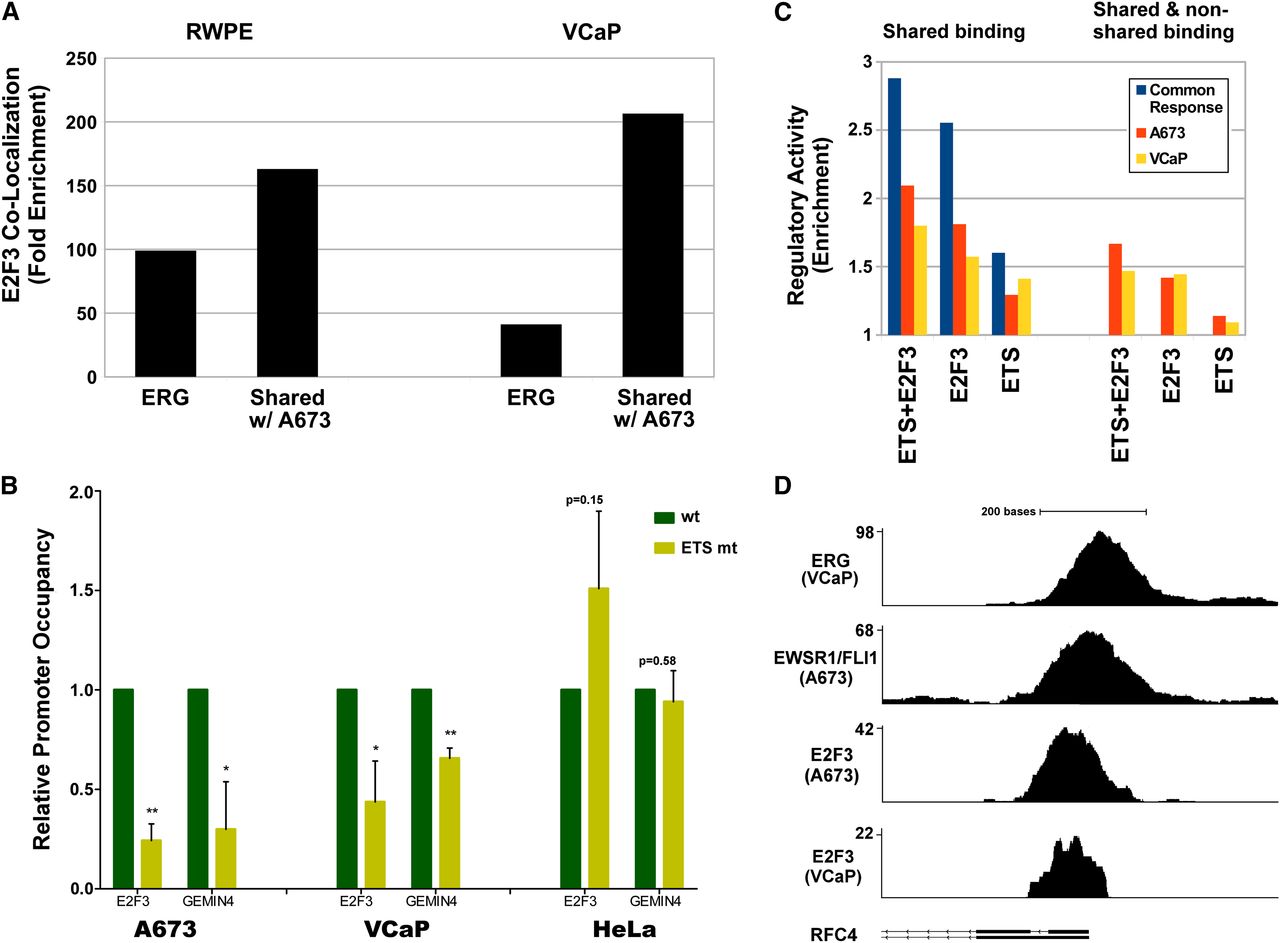
Comparison of ETS factor binding and transcriptional regulation in prostate and ES cells. (A) ERG binding in RWPE and VCaP prostate cells occurs preferentially in regions bound by E2F3 in A673. Shown is the enrichment of ERG or TMPRSS2/ERG binding events in proximity to E2F3 binding regions calculated by comparison to a flat, random background model. Enrichment is even stronger for the component of ERG binding that overlaps that of EWSR1/FLI-1 in A673. (B) The occupancy by E2F3 in the promoter of E2F3 and GEMIN4 is significantly reduced in the models for ES (A673) and prostate cancer (VCaP) for promoters with a mutated ETS recognition site in comparison to wild-type sequence. In HeLa cells, mutation of the ETS recognition site does not significantly change E2F3 binding. (C) Enrichment of ETS fusion and E2F3 binding in proximity to genes positively regulated by the fusions in their respective cells (right half) and for binding events shared across A673 and VCaP cells (left). Shown is the enrichment of such genes positively regulated by ETS in VCaP (yellow), A673 (orange), or in the set of genes responsive in both cell types (blue). (D) Read densities in the promoter region of a representative ETS responsive cell cycle gene RFC4 illustrating similarity of overlapping binding by TMPRSS2/ERG and EWSR1/FLI1 with E2F3 in VCaP and A673 cells. See Supplemental Figure S5 for transcription factor motif analysis.