


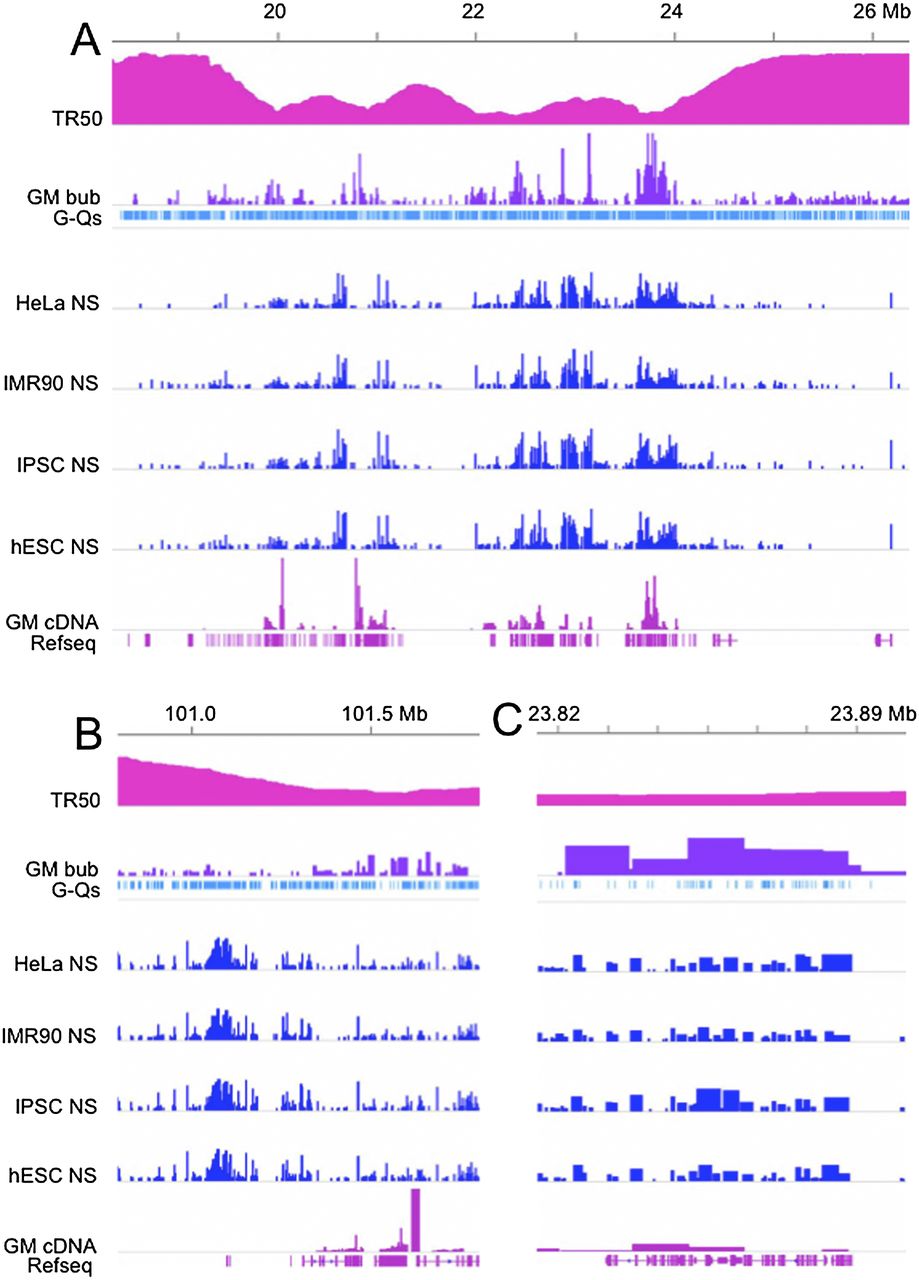
Concordance among bubble-containing fragments, small nascent strands, active transcripts, and G-quadruplexes. IGV screen shots of demonstrative segments of chr 14 at increasing magnifications, comparing TR50, bubble-containing fragment calls, NS calls, GM06990 cDNAs, and the G-quadruplex sequence identified as shared by >90% of all NSs (Besnard et al. 2012). (A) An ∼8-Mb global view of the left end of chr 14 suggesting relatively good concordance between NS calls and bubble-containing fragments identified in the present report, particularly in early-replicating regions (i.e., low TR50s). (B) An ∼1-Mb region from the right end of chr 14 displaying two different subregions that exhibit both high and low concordance between NSs and bubble-containing fragments, as well as a clear association between the G-quadruplex sequence and NS (but not bubbles). (C) An ∼70-kb window of good concordance between NSs and bubble-containing fragments, illustrating the presence of NSs throughout the length of the larger bubble-containing fragments. IGV data scales or settings are as follows: TR50/0–5.4; GM06990 bubble distributions/0–0.3; G-quadruplex distributions/collapsed setting; NS distributions/0–400; and GM06990 cDNA distributions/0–0.5.



