


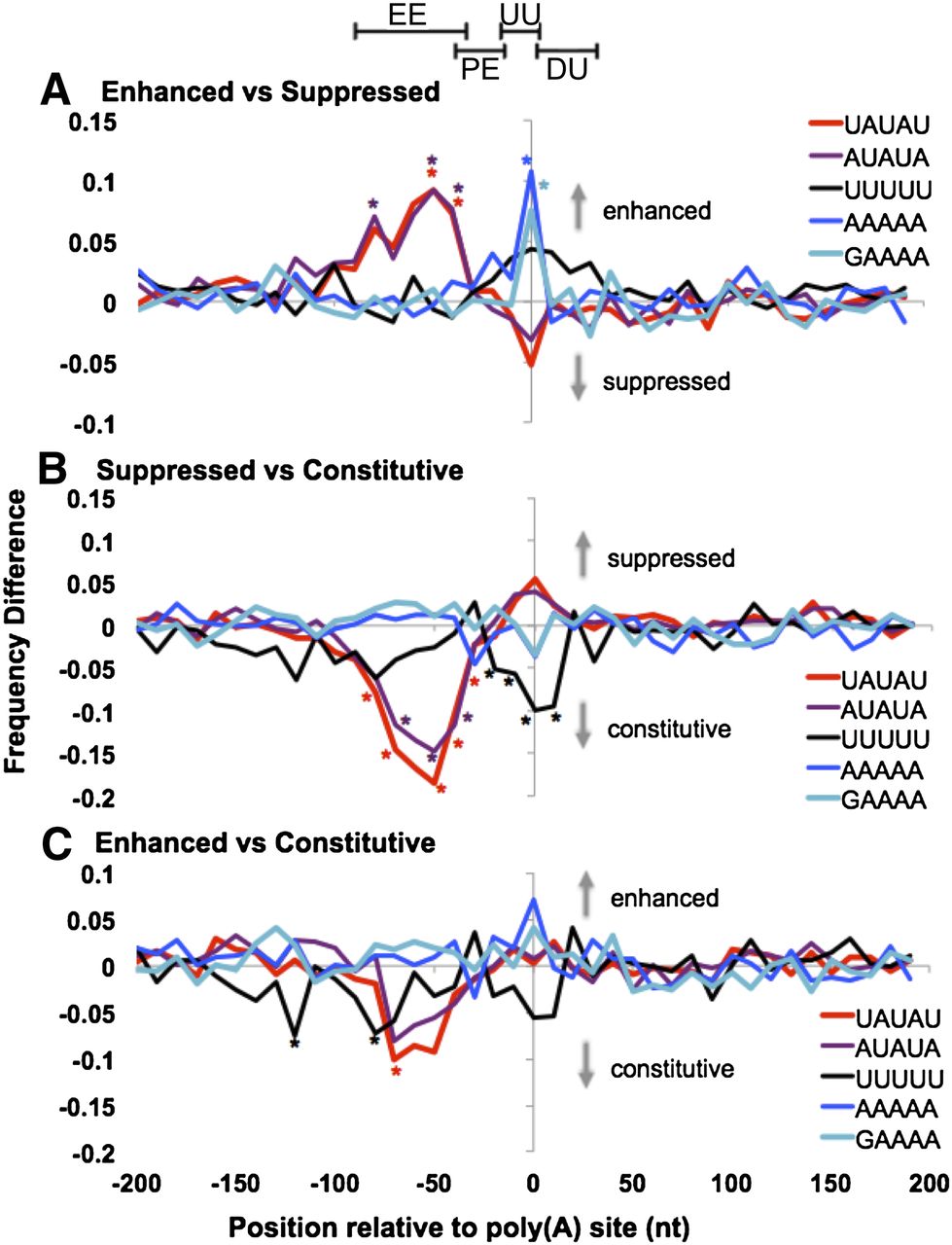
Sequence differences in the cis-elements that flank different classes of poly(A) sites. (A) Differences between enhanced and suppressed poly(A) sites plotted as the difference in the fraction of the poly(A) sites in each set with a match to the representative pentamers as a function of position relative to the poly(A) site. As indicated by the gray labels and arrows, positive (negative) values indicate more frequent occurrence in the flanks of enhanced (suppressed) sites. Asterisks mark pentamer-position pairs that passed DPWC statistical significance tests. (B) Same as A, but calculated in comparison to 4NQO-suppressed and constitutive poly(A) sites. As indicated by the gray labels and arrows, positive (negative) values indicate more frequent occurrence in the flanks of suppressed (constitutive) sites. (C) Same as in A and B, but for a comparison of 4NQO-enhanced and constitutive poly(A). As indicated by the gray labels and arrows, positive (negative) values indicate more frequent occurrence in the flanks of enhanced (constitutive) sites. The positioning of the cis-elements of the model previously developed for yeast poly(A) site prediction (Graber et al. 2002) is shown at the top for reference. (EE) Efficiency element, with optimal sequence UAUAUA; (PE) positioning element, characterized as adenine-rich; (UU) upstream uracil-rich element; (DU) downstream uracil-rich element.



