


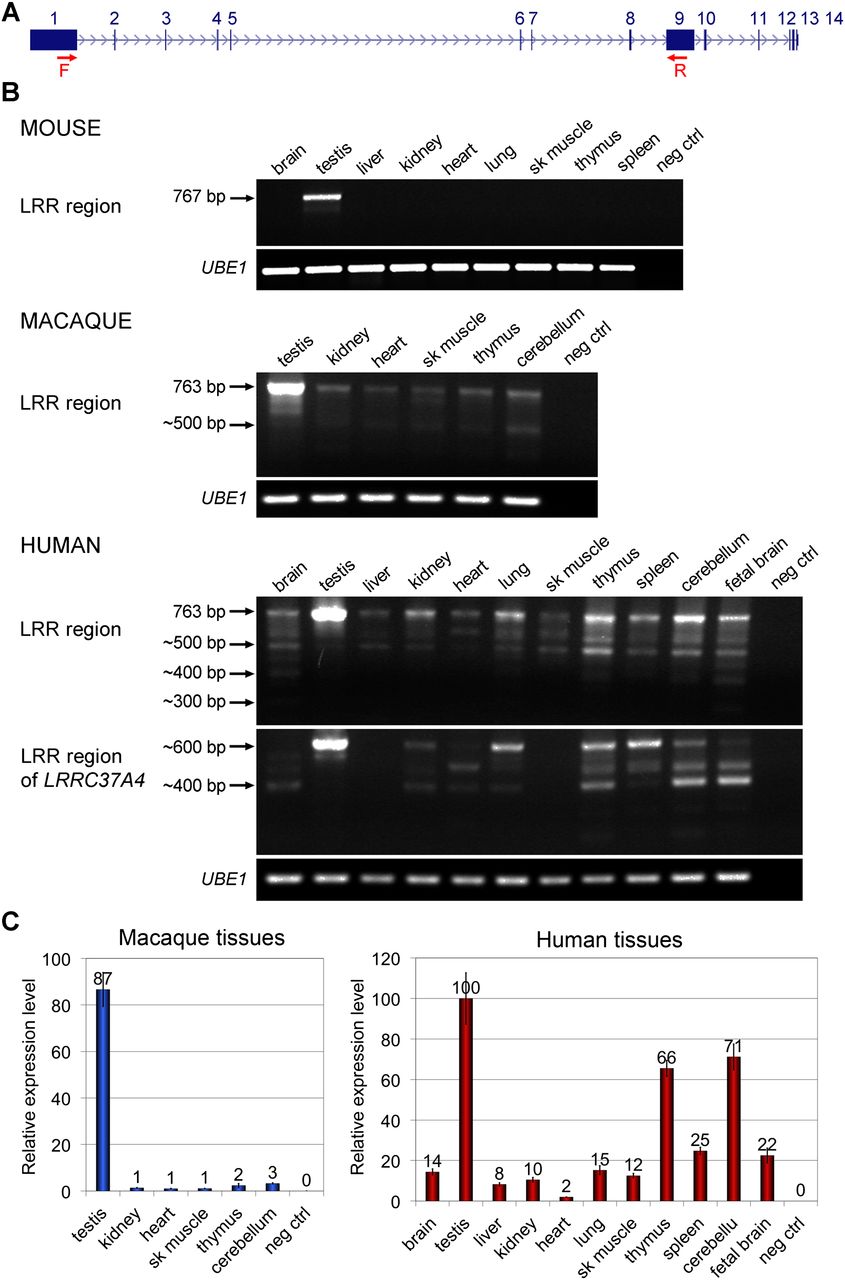
Tissue expression patterns of the LRRC37 family. RT-PCR and RT-qPCR results of the amplification of cDNA prepared from a panel of human tissue total RNA (Clontech) and from macaque and mouse tissue total RNA. UBE1 amplification was used as a control. (A) Human LRRC37A structure indicating the position of the primers used in RT-PCR experiments (red arrows). Forward primers were designed at the end of exon 1 and reverse primers at the beginning of exon 9 to amplify the LRR region. (B) Mouse Lrrc37a is expressed only in testis. The length of the complete LRR region of Lrrc37a2 is 767 bp. Minor products with shorter length are present. Degenerated primers have been designed for macaque and human to amplify all copies of the family. In both, the LRRC37 family is expressed in all the tissues tested, with the highest expression in testis. The expected size of the complete LRR region is 763 bp, but several products of smaller size are noted. The same forward primers and a reverse primer specific for the human LRRC37A4 copy have been tested in human tissue cDNA. There is no expression of the LRRC37A4 copy in liver and skeletal muscle. (C) Quantitative expression profiling of the LRRC37 family in macaque tissues and of LRRC37A, A2, A3, and A4 in human tissues. CT values are shown and calculated by comparative CT method (Livak and Schmittgen 2001) with UBE1 as the reference gene. In macaque, expression values are relative to heart. In human, the highest value of expression in the assay (testis) is set to 100. (Error bars) Standard error of the mean.



