


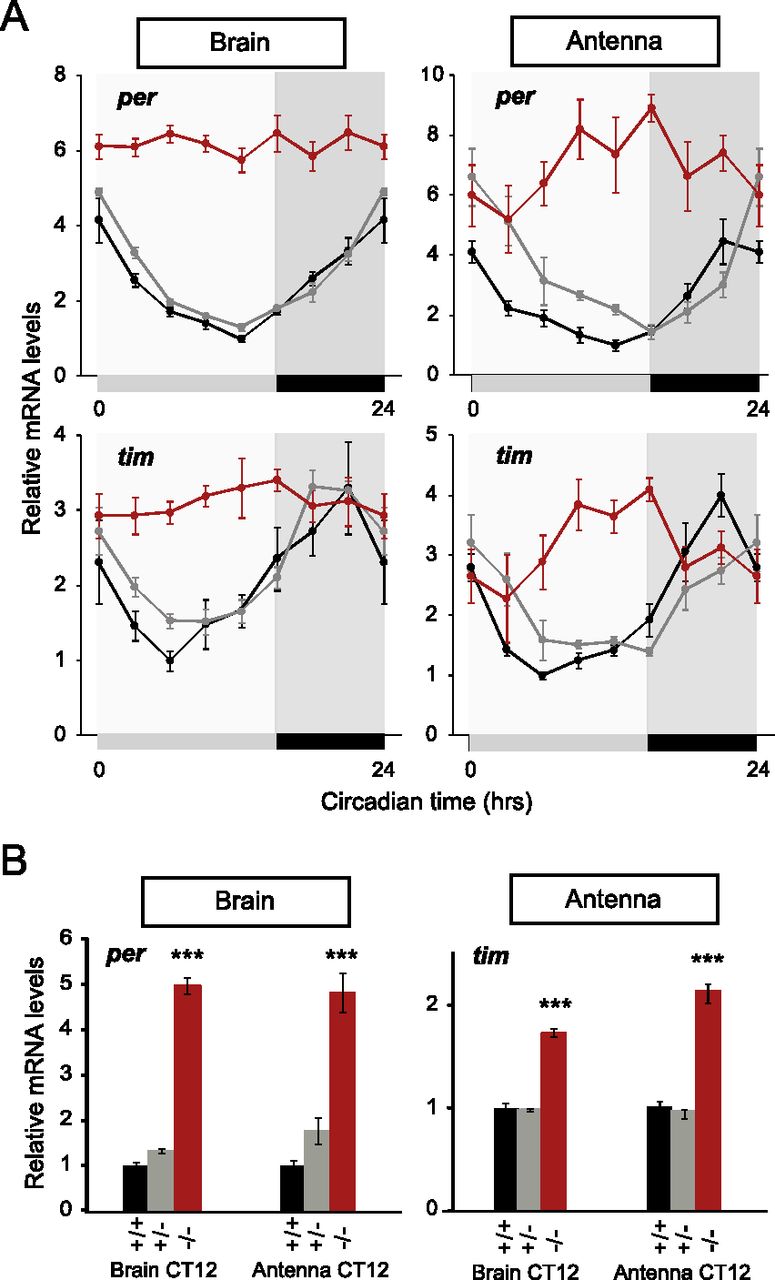
CRY2 deficiency disrupts the molecular clockwork. (A) Circadian expression of per and tim in brains and antennae of adult wild-type in constant darkness (DD) of wild-type (black lines), heterozygous (gray lines), and homozygous mutant (red lines) siblings of the 4-bp deletion cry2 mutant line entrained to LD throughout their larval and pupal stages. Values are mean ± SEM of four animals. Interaction genotype × time, two-way ANOVA: per in brain, P < 0.0001; per in antenna, P < 0.0001; tim in brain, P < 0.005; tim in antenna, P < 0.0001. (Box shading: light gray) Subjective day; (dark gray) night. (B) Expression levels of per and tim in brains and antennae of adult from the three genotypes of the 2-bp insertion cry2 mutant line at circadian time (CT)12, which corresponds to the trough of per and tim rhythmic expression in wild type. One-way ANOVA: P < 0.0001 for per and tim in both tissues; post-hoc t-test: P < 0.05 for per and tim between wild-type and knockouts, and heterozygotes and knockouts in both tissues. Values are the mean ± SEM of six animals. (Black bars) Wild type (+/+); (gray bars) heterozygous mutants (+/−); (red bars) homozygous mutants (−/−).



