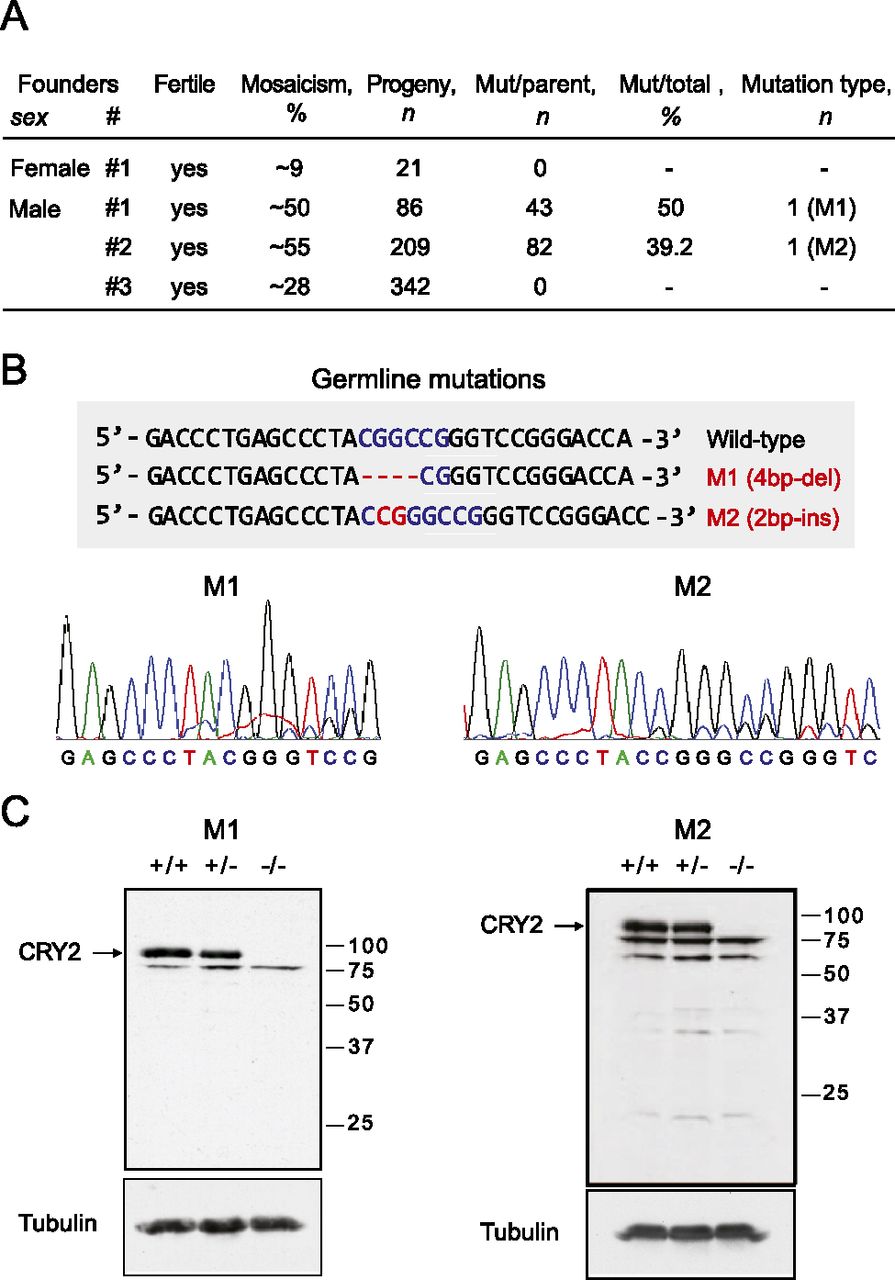
Germline transmission of cry2 ZFN-targeted mutations. (A) Table of heritable NHEJ mutagenesis at the cry2 locus. Potential founders (sex and number) presenting a high level of targeting in somatic cells that produced fertile crosses and those that yielded mutant progeny are shown. The approximate level of mosaicism, the number of progeny screened, the number of mutants per parent, the percentage of mutants in the progeny of each founder, and the number and name of mutations recovered are reported. The level of mosaicism was estimated by quantification of ethidium bromide staining and densitometry of the resistant band relative to wild-type fragments. (B) Alleles carried by founders showing mutations at the targeted site, a 4-bp deletion (M1) and a 2-bp insertion (M2), respectively, transmitted to 50% and 39.2% of the offspring (see above). Both mutations cause frameshifts leading to truncated proteins. (Top) Sequences; (bottom) chromatogram profiles. (C) Western blot analyses of CRY2 in brains of sibling wild-types (+/+), and heterozygous (+/−) and homozygous (−/−) mutants for each mutation. (Left) Four-base-pair deletion (M1); (right) 2-bp insertion (M2). The specific band recognized by a monarch-specific anti-CRY2 antibody directed against the C terminus of the protein (lacking in homozygous mutants) is identified by the arrow on the left of each panel.